How Colour Prediction Scams Work in India – Red Flags and Warning Signs 2026
Millions of Indians encounter colour prediction platforms every year through social media, YouTube videos, WhatsApp groups, and Telegram channels. Most first encounters look the same — a friend or influencer showing apparently easy earnings, a smooth onboarding process, a quick first win, and a withdrawal that actually works.
Then things change.
Understanding how colour prediction scams work in India is not about labelling every platform a scam. It is about recognising the patterns, tactics, and structural features that separate platforms designed to genuinely serve users from those designed primarily to extract money from them. This guide documents those patterns clearly — drawn entirely from independent public reports, user testimonials, and investigative findings available in the public domain.
No platform is specifically targeted as a scam in this guide. The focus is on tactics and patterns that users should be able to recognise wherever they encounter them.
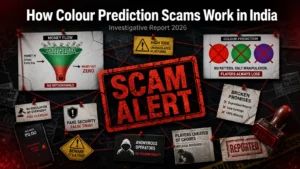
The Anatomy of a Colour Prediction Scams
Not every colour prediction platform is a deliberate scam in the traditional sense — some are simply unregulated platforms operating on a house-edge model that inevitably disadvantages users over time. But within the broader category, a specific pattern of behaviour has been documented consistently enough across independent sources that it deserves clear analysis.
The pattern typically unfolds in stages.
Stage 1 — The Hook
The user encounters the platform through an influencer, a friend’s referral, a YouTube video, or a Telegram group. The promotional content typically includes screenshots of earnings, withdrawal confirmations, and claims of consistent daily income. The message is clear and simple: this platform pays, it is easy, and others are already benefiting.
The hook works because the promotional content is often partially true — early users in a platform’s growth phase frequently do receive payouts because the platform needs positive word-of-mouth to grow its user base.
Stage 2 — The Trust Build
The new user registers, makes a small first deposit, and participates in a few rounds. An early win occurs — sometimes naturally, sometimes through platform mechanics that favour new users in initial rounds to build confidence. A small withdrawal is processed quickly. The experience is positive and consistent with what was promised.
This stage is designed to build trust and lower psychological resistance to larger deposits. The platform has invested a small amount in positive early experience to unlock larger future deposits.
Stage 3 — The Escalation
Feeling confident, the user increases deposits. Promotional content — from the platform, affiliated influencers, or Telegram prediction groups — encourages further investment. Referral commissions incentivise the user to recruit friends and family, deepening their personal and social investment in the platform’s success.
Stage 4 — The Friction
Withdrawal requests for larger amounts begin encountering problems. Delays appear. Requests are rejected with vague explanations — “suspicious activity,” “verification required,” “technical issues.” Support becomes less responsive. The account may be restricted or flagged.
In some cases, users are told they must deposit more to “unlock” withdrawal capabilities — a classic escalation tactic designed to extract additional funds from users who are trying to recover their existing balance.
Stage 5 — The Exit
The user either loses their deposits through continued play under the house edge, has their withdrawal requests permanently denied, or encounters account closure. In some cases the platform itself disappears — domain gone, APK link dead, support contact unreachable.
Common Colour Prediction Scams Tactics
Beyond the broader pattern above, several specific tactics appear repeatedly in independent reports of colour prediction scam india cases.
Fake “prediction signal” groups
Telegram and WhatsApp groups claim to offer guaranteed prediction signals — tips about which colour will appear in the next round. These groups are almost always run by affiliates whose income depends on getting users to register and deposit through their referral links. The signals themselves have no mathematical basis — RNG results cannot be predicted.
The scam works because early signals occasionally align with results by chance, creating the impression of genuine predictive ability. Users who believe the signals increase their deposits. The affiliate earns from the activity.
Fake withdrawal screenshots
Promotional content frequently features withdrawal confirmation screenshots. Some of these are genuine — from early users, small amounts, or promotional withdrawals made specifically to generate credible marketing material. Many are fabricated or heavily cropped to remove context. Users have no way to independently verify the authenticity of withdrawal screenshots shared on social media.
“Recharge to withdraw” manipulation
A documented tactic involves telling users that their withdrawal is pending but requires a minimum new deposit to process. This is a manipulation tactic — legitimate platforms do not require new deposits to process existing withdrawal requests. Any platform that makes this demand should be treated as attempting to extract additional funds under false pretences.
Fake “VIP” or “premium” tiers
Some platforms offer “VIP membership” tiers that promise higher withdrawal limits, better odds, or priority processing. These tiers require additional deposits to unlock. The implied benefits rarely materialise in the way described, and users who pay for VIP status report the same withdrawal friction as regular users when attempting to recover funds.
Multiple domain confusion
Colour prediction scam operations frequently operate across multiple domains simultaneously. When one domain is blocked or flagged, users are directed to another. This creates ongoing confusion about which URL is official and creates opportunities for fake lookalike sites that collect deposits without any connection to the original platform.
Influencer-driven false legitimacy
Paid influencer promotion creates an impression of platform legitimacy that is not earned by the platform’s operational standards. When a YouTube channel with 500,000 subscribers promotes a colour prediction app, viewers interpret the endorsement as a credibility signal. In most cases, the influencer is simply earning a referral commission and has not independently verified the platform’s reliability, regulatory status, or withdrawal behaviour at scale.
Red Flags Checklist
These warning signs apply to any colour prediction platform. The presence of multiple red flags in a single platform should be treated as a serious warning.
🚩 No visible company registration
A legitimate business operating financial transactions has a verifiable registration number, registered address, and named directors. Absence of this information is the single most important red flag.
🚩 APK-only distribution
No Google Play Store listing means no independent vetting of the app. The file has not been reviewed for malware, excessive permissions, or policy violations.
🚩 Excessive influencer promotion with income claims
Platforms that rely heavily on influencer promotion with earnings screenshots and daily income claims are almost always operating an affiliate-driven growth model. The income claims are not representative of typical user outcomes.
🚩 Guaranteed prediction signals or tricks
Any person, group, or tool claiming to predict RNG-based results is lying. RNG is designed to be unpredictable. Anyone promoting such content is earning referral commissions from users they mislead.
🚩 Withdrawal complaints at scale
Search the platform name with “withdrawal problem” independently. High complaint volume from multiple independent users is a meaningful signal — not isolated dissatisfaction.
🚩 “Recharge to withdraw” demands
Any instruction to deposit more money in order to release an existing withdrawal is a manipulation tactic. Stop immediately.
🚩 No responsible gaming policy
A platform that does not acknowledge the financial risks of its product and does not provide responsible gaming information is not operating with user welfare in mind.
🚩 Unrealistic daily earning claims
Claims of ₹5,000–₹50,000 daily income from colour prediction are not representative of typical user outcomes. The house edge guarantees platform profitability and user losses in aggregate.
🚩 Multiple domain variants
Operating across multiple domains simultaneously indicates an awareness that domains get blocked and a structural preparation for that eventuality — not a sign of transparent, stable operation.
🚩 No RBI authorisation or SRO registration
Any platform handling Indian user funds without RBI authorisation and operating without Online Gaming Act, 2025 SRO registration is operating outside India’s formal financial and gaming regulatory framework.
How These Scams Actually Make Money
Understanding the business model behind colour prediction scams india operations helps explain why they are structured the way they are.
Primary revenue — house edge:
Every wager placed on any prediction game generates approximately 4% revenue for the platform through the house edge. On a platform processing millions of small bets daily, this creates substantial revenue even before any deliberate withdrawal manipulation.
Secondary revenue — affiliate commissions:
The platform pays affiliates — influencers, Telegram group operators, YouTube creators — a commission for every user they recruit. The commission is typically funded from the platform’s house-edge revenue. Affiliates are incentivised to recruit as many users as possible, regardless of user outcome.
Tertiary revenue — withdrawal manipulation:
In platforms that deliberately manipulate withdrawals, the refusal to process larger withdrawal requests creates an additional revenue stream — user funds that are never actually paid out. This is the most predatory element and is not present in every platform in this category — but it is documented consistently enough in independent public reports to warrant explicit mention.
Who Is Most Vulnerable – Colour Prediction Scams
Understanding who is most likely to be affected by colour prediction scams in India helps frame both the individual and social dimension of the problem.
Young adults with limited financial literacy are the most frequently reported demographic in victim accounts. Fast-cycle gaming, mobile-first design, and social media-driven promotion target this group effectively.
Users in financial stress seeking supplementary income are particularly vulnerable to income claims. The promise of ₹500–₹1,000 per day from a simple app is compelling to someone who genuinely needs the money — and the risk of loss is highest for those who can least afford it.
Users in rural and semi-urban areas with fewer entertainment options and growing smartphone access represent a significant and growing portion of colour prediction platform user bases. Enforcement in these areas is less visible, and financial literacy around digital gaming products is lower.
Frequently Asked Questions – Colour Prediction Scams
Q1. How do colour prediction scams work in India?
The typical pattern involves a promotional hook through social media or referrals, a positive early experience with small deposits and withdrawals, increasing deposit escalation, and eventual withdrawal friction or refusal at higher amounts. Specific tactics include fake prediction signals, fabricated withdrawal screenshots, “recharge to withdraw” demands, and influencer-driven false legitimacy claims.
Q2. Are all colour prediction platforms scams?
Not every colour prediction platform is a deliberate scam in the traditional sense. Some are simply unregulated platforms that operate on a house-edge model that disadvantages users in aggregate over time. However, the absence of regulation, consumer protection, and corporate transparency creates conditions where predatory behaviour can occur without accountability.
Q3. How do I identify a colour prediction scams before losing money?
Check for: no visible company registration, APK-only distribution, heavy influencer promotion with income claims, guaranteed signal groups, high independent withdrawal complaint volume, and no responsible gaming policy. Multiple red flags together indicate a high-risk platform regardless of the name.
Q4. Are prediction signal groups on Telegram real?
No. Prediction signal groups claim to predict RNG-based results. RNG systems are designed to produce unpredictable outcomes. No signal, algorithm, or system can reliably predict RNG outputs. These groups are almost universally operated by affiliates earning referral commissions from users who join platforms through the group’s links.
Q5. What should I do if a platform tells me to deposit more to unlock my withdrawal?
Stop immediately. Do not deposit any additional funds. This is a documented manipulation tactic — legitimate platforms do not require new deposits to process existing withdrawal requests. Document everything — screenshots of the demand and all transaction records — and cease all further financial engagement with the platform.
Q6. Can I get my money back if I was scammed by a colour prediction platform?
Formal recovery options are limited for unregistered platforms. You can file a complaint with your state’s cybercrime unit — particularly in states where online gambling is prohibited. You can also report to MeitY and your UPI service provider. Actual fund recovery depends on individual circumstances and is not guaranteed. Consulting a legal professional about options under Indian consumer law is advisable if the amount is significant.
Q7. How do I report a colour prediction scams in India?
Report to: the National Cyber Crime Reporting Portal (cybercrime.gov.in), your state cybercrime unit, MeitY through its grievance mechanism, and your UPI payment provider. In states where online gambling is prohibited, reporting to local police is also an option. Keep all documentation — transaction records, screenshots, and communication logs — before making any report.
This content is for educational and informational purposes only. We do not promote or endorse any gaming platform. No affiliate links are present. Nothing here constitutes financial, legal, or investment advice.
