Responsible Gaming India – Complete Guide to Recognising Risk and Playing Safely
Responsible gaming India is one of the most important topics in India’s online gaming conversation — and one of the least discussed. Most gaming content in India focuses on platforms, features, earnings, and strategies. Very little focuses on the point where gaming stops being entertainment and starts causing harm.
This guide fills that gap. It is written for Indian users at every stage — those who are curious about whether their gaming behaviour is healthy, those who are concerned about a friend or family member, and those who are already experiencing problems and need to know where to turn.
No platform is promoted here. No gaming is encouraged. This is purely an educational resource focused on user welfare, harm recognition, and practical support.
What Is Responsible Gaming And Responsible Gaming India?
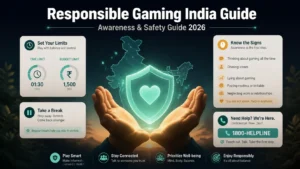
Responsible gaming is the practice of engaging with any form of gaming — skill-based, chance-based, prediction, lottery, or otherwise — within clearly defined financial and time boundaries, with full awareness of the risks involved, and with the ability to stop without distress when those boundaries are reached.
Responsible gaming is not about never playing. It is about playing with control — knowing your limits before you start, sticking to them when you are playing, and recognising when the activity has moved from voluntary entertainment to something that is harder to control.
The key characteristics of responsible gaming are:
- Pre-set financial limits — deciding the maximum you will spend before you start, not after
- Time awareness — knowing how long you have been playing and stopping when planned
- Emotional detachment from outcomes — accepting losses without needing to chase them
- Financial prioritisation — never using money allocated to essential needs for gaming
- Honest self-assessment — being able to evaluate your own behaviour without denial
When any of these characteristics is consistently absent, the gaming behaviour warrants closer attention.
Understanding Problem Related to Responsible Gaming India
Problem gaming — sometimes called problem gambling or gaming disorder — is a recognised behavioural condition in which gaming activity becomes compulsive, persistent, and difficult to control despite negative consequences.
The World Health Organisation formally recognised Gaming Disorder in ICD-11 (International Classification of Diseases, 11th Revision). While ICD-11’s gaming disorder classification was initially focused on video gaming, the same diagnostic framework applies to online wagering and prediction gaming when the behavioural patterns are present.
Problem gaming in the context of colour prediction and lottery apps in India is particularly relevant because these platforms are specifically designed around features that research has linked to higher addiction risk:
- Short cycle times — WinGo’s 60-second rounds mean a new opportunity appears every minute
- Variable reward schedules — intermittent wins create stronger compulsive engagement than consistent wins
- Continuous availability — mobile-first design means the platform is accessible 24 hours a day
- Loss-chasing design — the next round is always available to recover a previous loss
- Social embedding — referral systems create social pressure to remain engaged
Understanding that these features are deliberate design choices — not accidental — is important context for any self-assessment.
Self-Assessment — Warning Signs
This self-assessment covers the most commonly recognised warning signs of problem gaming behaviour. Read each question honestly. If you answer yes to three or more, consider seeking support.
Financial warning signs:
- Have you spent more on gaming in a single session than you originally planned?
- Have you deposited money needed for rent, food, bills, or savings into a gaming platform?
- Have you borrowed money — from anyone — to fund gaming deposits?
- Have you sold possessions or delayed essential payments to continue gaming?
- Have you hidden gaming expenditure from family members or partners?
Behavioural warning signs:
- Do you find yourself thinking about gaming when you are doing other things?
- Have you tried to cut back on gaming and found it harder than expected?
- Do you feel restless, irritable, or anxious when you are not able to play?
- Have you returned to gaming immediately after losing to try to recover the amount?
- Has gaming gradually taken more of your time than you initially intended?
Emotional and social warning signs:
- Has gaming caused arguments or tension with family members or friends?
- Have you lied to someone close to you about how much time or money you spend on gaming?
- Do you use gaming to escape stress, anxiety, boredom, or unhappy feelings?
- Have you felt guilt or shame about your gaming behaviour but continued anyway?
- Has gaming affected your work, studies, or daily responsibilities?
Escalation warning signs:
- Do you find you need to deposit larger amounts to get the same feeling of excitement?
- Have you chased losses — deposited more specifically to try to win back what you lost?
- Have you continued playing despite telling yourself you would stop?
- Has the scale of your gaming increased significantly over the past three to six months?
If you answered yes to three or more questions across any category, your gaming behaviour warrants honest attention and potentially professional support.
The Chasing Losses Cycle
Loss-chasing is the single most damaging behavioural pattern in problem gaming — and one of the most important to understand for anyone using colour prediction apps.
The cycle works like this:
- A loss occurs — money is gone and the emotional response is discomfort or distress
- The immediate resolution the platform offers is always the same — another round, one minute away
- The user deposits more to recover the loss — this feels like a logical, active response to the problem
- The new deposit is subject to the same house edge as every previous one — statistically, it is no more likely to produce a win
- If it produces a loss, the cycle repeats at a higher emotional intensity and often a higher stake level
The mathematical reality of the house edge means this cycle has a predictable long-term outcome — the platform retains approximately 4% of all aggregate wagering. Loss-chasing does not change this mathematics. It accelerates it. Each deposit made to chase a loss increases the total amount subject to the house edge.
Recognising the chasing cycle early — before the amounts become seriously damaging — is the most effective intervention point. The moment you make a deposit specifically to recover a previous loss rather than as a planned entertainment expenditure, you have entered the chasing cycle.
The correct response is to stop immediately. Not after the next round. Not after recovering the amount. Immediately.
Setting Limits — Practical Tools
For users who want to continue gaming responsibly, these practical limit-setting tools reduce the risk of harm.
Financial limits:
Set a firm maximum gaming budget — monthly, weekly, or per session — before you begin. This amount should be money you are genuinely prepared to lose entirely. It should have no connection to essential expenses. Write it down. Tell someone you trust. The act of stating a limit externally makes it significantly harder to breach.
Time limits:
Set a maximum session length before starting — 30 minutes, one hour. Use a timer. When it ends, stop. The availability of the next round in 60 seconds is specifically designed to make stopping feel premature. A pre-set time limit removes the platform’s ability to define when the session ends.
Cooling-off periods:
If you experience a significant loss or a session that exceeded your planned limits, impose a mandatory cooling-off period before playing again — 24 hours, 48 hours, or longer. This breaks the loss-chasing cycle at the point where it is most likely to escalate.
Deposit reviews:
At the end of every month, review your total gaming deposits and withdrawals. A net negative — more deposited than withdrawn — is the expected mathematical outcome on house-edge platforms over time. Seeing the cumulative figure clearly is often more effective than tracking individual sessions.
Registered platform tools:
On regulated platforms — WinZo, MPL, and others registered under the Online Gaming Act, 2025 — built-in responsible gaming tools are available. These include deposit limits, session time controls, and self-exclusion options that remove access to the platform for a defined period. Unregistered platforms like Daman Game do not provide these tools — which is itself a safety reason to prefer regulated alternatives.
Self-Exclusion to follow Responsible Gaming India
Self-exclusion is the voluntary act of removing your own access to a gaming platform for a defined period. It is the most effective mechanical intervention available for users who recognise their behaviour has become problematic and want to create a barrier to continued play.
On regulated platforms:
Registered platforms under the Online Gaming Act, 2025 are required to offer self-exclusion as a responsible gaming feature. Users can typically set exclusion periods from 24 hours to permanent account closure through the platform’s responsible gaming settings.
On unregistered platforms:
Colour prediction platforms like Daman Game do not provide formal self-exclusion tools as a compliance requirement. Users who want to stop using these platforms must take their own steps — deleting the app, removing the APK, blocking the domain on their device, and if necessary, asking a trusted person to help maintain that barrier.
Device-level blocking:
For users who find app deletion insufficient, Android and iOS devices both provide options to block specific websites and set app usage limits through built-in parental controls or third-party screen time management apps. These can be password-protected by a trusted person to create a more robust access barrier.
Supporting Someone Else
If you are concerned about a friend or family member’s gaming behaviour rather than your own, these guidelines apply.
Approach without accusation.
Conversations about problem gaming are most effective when they come from a place of concern rather than judgment. Starting with “I’ve noticed you seem stressed about money lately — is everything okay?” is more likely to open dialogue than “you’re gambling too much.”
Focus on specific observations.
Reference specific things you have seen or heard — changes in mood, financial stress, increased time on the phone, social withdrawal — rather than general characterisations. Specific observations are harder to dismiss.
Do not cover financial losses.
Lending money or covering expenses created by gaming losses removes the natural consequence that most clearly demonstrates the problem has real costs. This is one of the most difficult aspects of supporting someone with a gaming problem — but it is also one of the most important.
Encourage professional support.
You are not equipped to treat a behavioural condition by yourself, and neither is the person experiencing it. Encouraging professional support — and offering to help find it — is the most useful role you can play.
Support Resources in India
If gaming is affecting your finances, relationships, mental health, or daily functioning, please use these resources.
iCare — Responsible Gaming Helpline
India’s primary responsible gaming support resource. Available for users who need guidance on gaming behaviour, financial recovery, and professional referrals.
iCall — TISS
Tata Institute of Social Sciences offers iCall — a psychological counselling service available by phone and email. Qualified counsellors provide confidential support for a range of behavioural and mental health concerns including problem gaming.
Website: icallhelpline.org
Vandrevala Foundation Helpline
24/7 mental health helpline available across India.
Phone: 1860-2662-345 / 1800-2333-330
National Mental Health Helpline — NIMHANS
National Institute of Mental Health and Neurosciences provides mental health support and referrals.
Phone: 080-46110007
iDream — Gambling Addiction Support
Community-based support network for individuals and families affected by gambling and gaming addiction in India.
Cybercrime Reporting — for fraud cases
If gaming has involved fraud — withdrawal refusals, scam APKs, or manipulation tactics — report to:
National Cyber Crime Reporting Portal: cybercrime.gov.in
Frequently Asked Questions – Responsible Gaming India
Q1. What is responsible gaming and why does it matter in India?
Responsible gaming is the practice of engaging with any gaming activity within pre-set financial and time limits, with full awareness of risks, and the ability to stop without distress. It matters in India because the country’s online gaming market has grown dramatically while regulatory protections for users remain incomplete — particularly for colour prediction and lottery apps that operate outside the formal framework.
Q2. How do I know if I have a gaming problem?
Key indicators include: spending more than planned, depositing essential funds, borrowing to fund gaming, hiding expenditure from family, chasing losses, feeling anxious when not playing, and finding it harder to stop than expected. Three or more of these indicators together warrant honest attention and potentially professional support.
Q3. What is loss-chasing and why is it dangerous?
Loss-chasing is depositing money specifically to recover a previous loss rather than as planned entertainment. It is dangerous because it accelerates the house edge’s mathematical effect — each new deposit made to chase a loss is subject to the same approximately 4% retention the platform applies to all wagers. The cycle typically escalates in both emotional intensity and financial scale before it is recognised.
Q4. What should I do if I want to stop using a gaming app?
Delete the app immediately. Remove any APK files. Block the domain on your device using parental controls or a screen time management app. Tell a trusted person. Impose a cooling-off period before reconsidering. If you find stopping difficult despite wanting to, contact iCall or the Vandrevala Foundation helpline for professional support.
Q5. Are there any tools to help control gaming on regulated apps?
Yes. Regulated platforms registered under the Online Gaming Act, 2025 are required to offer deposit limits, session time controls, and self-exclusion options. These tools are built into the platform’s responsible gaming settings. Unregistered platforms like colour prediction apps do not provide these tools — which is a significant reason to prefer regulated alternatives for any gaming activity.
Q6. How can I help a family member with a gaming problem?
Approach with concern rather than accusation. Reference specific observations — financial stress, mood changes, excessive phone use. Do not cover financial losses. Encourage professional support and offer to help find it. Contact iCall or the Vandrevala Foundation for guidance on how to support someone with a gaming-related behavioural concern.
Q7. Is problem gaming a recognised condition in India?
Gaming Disorder is formally recognised by the World Health Organisation in ICD-11. Indian mental health professionals and organisations including NIMHANS and TISS’s iCall provide support for gaming-related behavioural concerns. Treatment approaches include cognitive behavioural therapy, financial counselling, and peer support programmes. Seeking help is not a sign of weakness — it is the most effective response available.
Q8. Where can I get immediate help for gaming-related financial crisis?
Contact the Vandrevala Foundation 24/7 helpline: 1860-2662-345. Contact iCall at TISS: icallhelpline.org. For fraud-related financial loss involving gaming platforms, report to cybercrime.gov.in. For legal guidance on recovering funds from fraudulent platforms, consult a qualified legal professional. Do not delay seeking help — early intervention produces significantly better outcomes than delayed action.
This content is for educational and informational purposes only. We do not promote or endorse any gaming platform. No affiliate links are present. Nothing here constitutes medical, financial, legal, or investment advice. If you are experiencing a mental health crisis, please contact a qualified professional immediately.
