Is Big Daddy Game Legal in India? What the 2025 Gaming Act Means for Players
Since Parliament passed the Promotion and Regulation of Online Gaming Act, 2025, many readers of our colour-prediction guides have asked a simple question: where does that leave real-money apps such as BDG Game? This explainer sets out what the law says, who it targets and what it means for ordinary users. It is general information for adults aged 18 and over, not legal advice, and it does not encourage anyone to deposit or play.
What the App Is and Why the Question Matters
Big Daddy Game is a real-money app marketed to players in India. Its best-known feature is colour prediction: users stake money on whether the next round will land on red, green or violet, or on a number or a “big” or “small” result. Rounds are short, sometimes a minute or less, and each one is settled by a result the player cannot influence. Deposits and withdrawals have typically moved through UPI.
That mix of money staked, chance-based results and fast repetition is exactly what lawmakers had in mind in 2025.
The economics matter too. Every round is built with a house edge, meaning payouts are set so that, over many rounds, the operator keeps a share of everything staked. The expected value for the player is negative. No pattern, tool or “prediction trick” changes that.
The Online Gaming Act, 2025 in Plain English
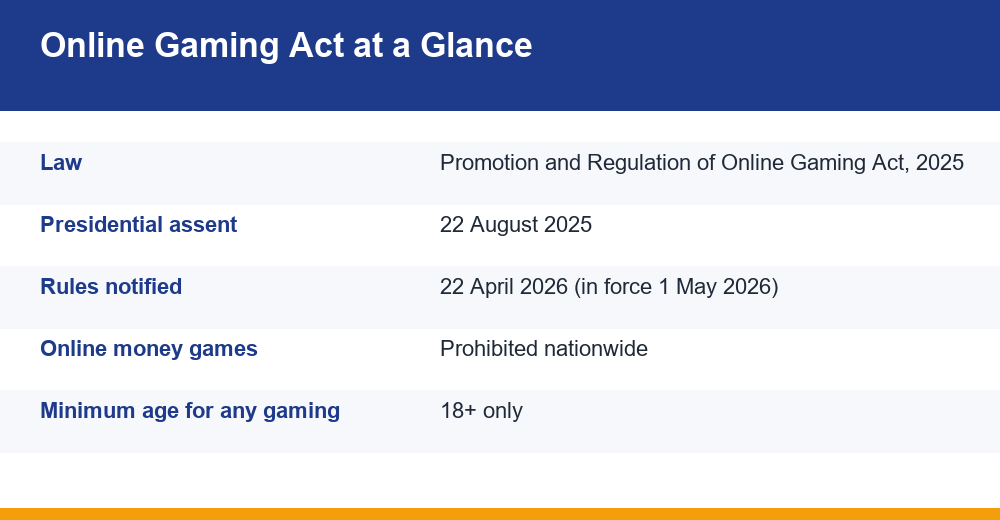
The Act was passed by the Lok Sabha on 20 August 2025 and by the Rajya Sabha the next day, and it received Presidential assent on 22 August 2025. It is a central law, so it applies across India rather than varying from state to state. It sorts online games into three groups, and the group decides how a game is treated.
| Category | What it covers | Position under the Act |
|---|---|---|
| E-sports | Competitive, skill-based games played in organised formats | Recognised and promoted; a registration framework applies |
| Online social games | Recreational or educational games without money stakes for winnings | Permitted and promoted |
| Online money games | Games where users pay or deposit money expecting monetary or other winnings | Prohibited, whether based on skill, chance or both |
The ban on online money games does not depend on the old “skill versus chance” debate. If a user pays money expecting to win money or similar rewards, the game is prohibited, however it is described in marketing. The Act also bans advertising and promotion of such games, bars banks and payment systems from processing their transactions, and lets the government order access to be blocked.
The Ministry of Electronics and Information Technology (MeitY) published draft rules in October 2025, then notified the final Promotion and Regulation of Online Gaming Rules, 2026 on 22 April 2026. They took effect on 1 May 2026 and set up the Online Gaming Authority of India, which, according to published legal summaries, can classify games, keep public lists of prohibited money games, hear complaints and take enforcement action.
Where Colour-Prediction Apps Stand Today
Applying the Act to the way the app is described, the answer looks straightforward. A platform where users deposit money, stake it on colour or number outcomes and hope to withdraw more fits the statutory description of an online money game, and such games are prohibited.
No formal ruling on this specific app is cited here, and the Online Gaming Authority has the power to decide whether a particular game is a money game. Still, the legal test looks at substance, not names. Calling a game “prediction”, “trading” or “lottery-style fun” does not move it out of the prohibited category.
For a closer look at how the app’s status has been discussed, an independent information site covers BDG Game and its legal position in India. Readers should weigh any such source against the text of the Act itself, which is the final word on what is permitted.
It also matters what the law does not do. According to widely reported summaries, it does not make players criminals; it treats them as people to be protected. Even so, using a prohibited service leaves users exposed to losses, blocked payments and little practical recourse.
Seven Facts Worth Remembering
- Online money games are banned nationwide. Offering, aiding or abetting them is prohibited, whether they rely on skill, chance or both.
- Advertising is banned too. That includes influencer posts and paid social campaigns.
- Payments are cut off at the source. Banks and payment gateways must not process these transactions.
- Blocking is possible. The government can order access to unlawful gaming services to be blocked.
- A regulator now exists. The Online Gaming Authority of India can classify games and run inquiries.
- Players are not the main target. Criminal penalties focus on operators, promoters and payment facilitators.
- Your money has weak protection. A user who cannot withdraw has few lawful ways to recover funds from an operator.
Penalties: Who the Law Targets
The figures below reflect the penalty provisions as widely reported. They are maximums, and a court decides any actual sentence. Anyone who needs certainty should check the official gazette text or consult a qualified lawyer.
| Who | Conduct | Maximum penalty (as reported) |
|---|---|---|
| Operators and facilitators | Offering or aiding online money games | Up to 3 years’ jail, a fine up to Rs 1 crore, or both |
| Advertisers and promoters | Advertising or promoting online money games | Up to 2 years’ jail, a fine up to Rs 50 lakh, or both |
| Financial institutions | Processing payments for online money games | Up to 3 years’ jail, a fine up to Rs 1 crore, or both |
| Repeat offenders | Repeating a covered offence | Higher penalties, widely reported as 3 to 5 years’ jail and fines up to Rs 2 crore |
Notice who is missing from that table: ordinary users. The Act reflects a view that people who play these games are more often victims of a harmful product than wrongdoers.
It also explains why the advertising ban matters. Influencers and affiliates who push referral links or “invite codes” can fall within the promotion offence.
Red Flags and Safe Checks for Users
This article does not claim that the app is a scam, and no such finding is cited here. But the wider colour-prediction market has produced many copycat apps, cloned websites and fake “official” Telegram channels, so it pays to know the common warning signs.
- Guaranteed profit claims: promises of fixed daily earnings or “sure-shot” tricks are false, because outcomes are chance-based with a house edge.
- APK-only downloads: apps shared through links rather than official stores bypass basic screening.
- Growing withdrawal conditions: extra “tax” or “unlock” fees before you can withdraw are a classic red flag.
- Pressure to recruit: referral chains shift losses onto friends and family.
- Payments to personal UPI IDs: changing individual accounts offer no traceable business identity.
Our checklist for spotting fake gaming apps in India walks through these signs in more detail.
If you have already lost money
Stop depositing straight away, keep records of every transaction and chat, and report the matter on the National Cyber Crime Reporting Portal (cybercrime.gov.in) or by calling the 1930 cyber fraud helpline. Quick reporting gives the best chance of freezing funds still moving through the banking system. Be wary of anyone offering to “recover” lost money for a fee; genuine help comes through the official portal, your bank and the police.
Responsible Choices and Where to Get Help
This site covers colour-prediction apps to inform, not to recruit. Under the 2025 Act, the simplest safe choice is not to deposit money into any online money game. Free social games and recognised e-sports remain lawful options for people who enjoy gaming.
If you are over 18 and still feel drawn to these apps, it helps to understand why. Fast rounds, near-misses and the urge to “win back” losses are powerful hooks. Our guide to responsible gaming in India explains practical limits, cooling-off steps and how to talk to family about money worries. Never play with borrowed money or savings meant for essentials, and anyone under 18 should stay away from real-money apps entirely.
Free, confidential mental-health support is available round the clock through Tele-MANAS on 14416 or 1-800-891-4416. For fraud, use cybercrime.gov.in or 1930. In short, start from the Act itself: online money games are prohibited, the house always holds the edge, and your money is at real risk.
Frequently Asked Questions
Can I be arrested for playing colour-prediction games?
According to widely reported summaries of the 2025 Act, criminal penalties target operators, advertisers and those who process payments, not ordinary players. Players still face real financial risk, blocked transactions and limited recovery options. This is general information, not legal advice.
Who decides whether a game is a money game?
The Online Gaming Authority of India, set up under the 2026 Rules in force from 1 May 2026, can classify games and maintain lists of prohibited money games. It looks at substance, such as whether users pay money for monetary gain.
What should I do if I cannot withdraw my balance?
Stop depositing, save screenshots, and report the issue at cybercrime.gov.in or on the 1930 helpline. Do not pay extra unlock or tax fees. If stress is building, Tele-MANAS on 14416 offers free, confidential support.
