
Fake customer care numbers – 6 Smart Checks Before You Dial
Fake customer care numbers are one of the most effective traps aimed at people who play on real-money gaming apps, precisely because they catch you at your most anxious moment — a stuck withdrawal, a frozen account, a login that suddenly fails. You search for a helpline, a number appears near the top, and the person who answers sounds calm, official and eager to fix everything. That person is almost never from the app.
The short version: most real-money gaming apps do not operate phone support at all, so nearly every number you find by searching is planted by someone who profits when you call. This breakdown explains how those numbers get planted, what actually happens on the call, and six checks that take less than two minutes before you ever dial. 18+ only — real-money play carries risk, and losses are the expected outcome over time.
The Short Answer
If you found a gaming app helpline number through a search engine, a social media post, a Telegram or WhatsApp group, or a comment thread — do not call it. The overwhelming majority of such numbers are placed there by scammers who impersonate support staff. Genuine real-money gaming apps resolve issues almost exclusively through in-app chat, support tickets and email, because phone lines are expensive to run and easy to impersonate.
That single fact is the whole defence. Once you accept that the app you use probably has no phone number at all, every number you encounter in the wild becomes suspect by default, and the burden of proof flips: the number has to prove it is real, rather than you having to prove it is fake. The rest of this piece earns that claim — how the planting works, what the call sounds like, and the exact checks that separate a genuine channel from a trap.
One more thing worth saying up front: if you have already called such a number and shared something, the situation is recoverable in steps, but speed matters. Jump to the reporting section below, and be aware that a second wave of scammers specifically targets people who were just cheated — the fund recovery scam that follows the first scam is often more damaging than the original one.
Why Fake Customer Care Numbers Appear in Search Results
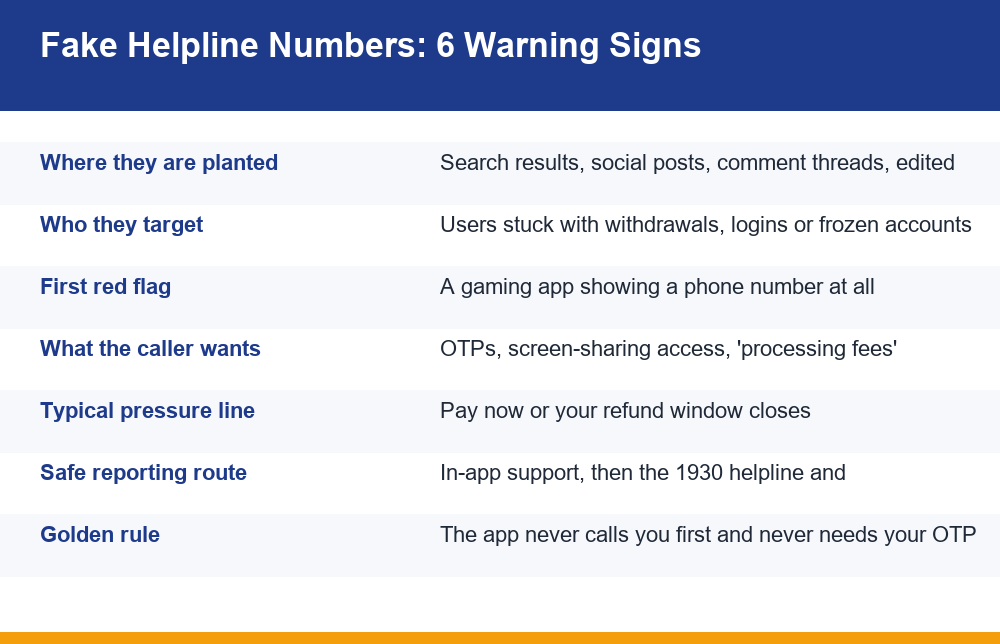
Fake customer care numbers do not rank by accident. Scammers deliberately exploit a gap: enormous numbers of worried users search phrases like “app name customer care number”, and the genuine app has published no number for that search to find. An empty search result is a vacuum, and scammers fill it cheaply and quickly.
The planting happens through a handful of repeatable methods, none of which require much skill:
- Spam blog posts and free-hosted pages stuffed with the app’s name plus the words “customer care number”, refreshed constantly so one takedown never matters.
- Hijacked or fake business listings on map services, where anyone can suggest an edit and attach a phone number to a listing that looks official.
- Social media posts and reels that display a “helpline” over the app’s logo, pushed through hashtags that worried users search.
- Comment-section seeding — under app reviews, video comments and forum threads, accounts post “I had the same issue, this number fixed it in 10 minutes” with the scammer’s number.
- Q&A and classifieds platforms, where a planted question (“what is the helpline for…?”) is answered minutes later by an accomplice account.
Because the posting costs nothing and a single successful call can drain an entire account, the economics strongly favour the scammer. Platforms remove listings when reported, but new ones appear the same day under new names. That is why no list of “known bad numbers” can protect you — only the habit of never trusting a searched-up number can.
There is also a timing element. Planted numbers spike around moments of mass frustration: an app going offline, a payment gateway outage, or an app disappearing from stores. When thousands of users are suddenly locked out and searching for help at once, the fake helplines are already waiting.
Do Gaming Apps Actually Have Phone Support?
Almost never — and understanding why makes the scam easier to see through. Running a phone helpline means staffing it in multiple languages across long hours, verifying every caller’s identity by voice, and accepting that any number you publish will be spoofed and cloned within days. For a real-money gaming app, the risk-to-benefit maths is terrible. Text-based channels, by contrast, leave a written record, happen inside an authenticated session where the app already knows who you are, and cannot be impersonated by a random SIM card.
So the typical genuine support stack for a real-money gaming app looks like this: an in-app chat or “Help” section you reach only after logging in, a support email published inside the app or on the app’s own website, and sometimes a ticket system. What it does not look like is a ten-digit mobile number on a blog, a number pasted in a Telegram group, or a WhatsApp contact that messages you first.
A mobile number is itself a red flag worth dwelling on. Legitimate businesses that do run phone support use fixed lines, toll-free numbers or call-centre ranges. A personal mobile number presented as the “official customer care” of a gaming platform is a near-certain sign you are looking at an individual with a prepaid SIM, not a company.
| Signal | Genuine support channel | Fake helpline |
|---|---|---|
| Where you find it | Inside the logged-in app or its own site | Search results, social posts, forwarded messages |
| Contact type | In-app chat, ticket, email | Personal mobile number, WhatsApp contact |
| Who speaks first | You open the ticket | They answer instantly or even call you first |
| Identity checks | You are already logged in | They ask for OTPs, PINs or card details |
| Fixing the issue | Done inside the app, no payment | Requires a ‘fee’, ‘deposit’ or screen-sharing app |
| Urgency | Normal queue, written replies | Act in minutes or lose your money |
What Happens When You Dial One
Calls to fake customer care numbers follow a script so consistent that describing one call describes nearly all of them. The person answers immediately — no queue, no hold music, which real support lines rarely manage — greets you with the app’s name, and asks for your registered mobile number and the problem. The early minutes are pure reassurance: yes, this is a known issue; yes, your money is safe; yes, it can be fixed today.
Then comes the pivot, and it takes one of three well-worn forms:
- The OTP route. “To verify your account, a code has been sent to your phone — please read it out.” That code is a one-time password for your payment app, bank or the gaming account itself. Reading it out hands over the account.
- The remote-access route. You are told to install a screen-viewing application so the “technician” can fix the problem directly. Once installed, they watch every PIN and password you type. This method is dangerous enough that it deserves its own full explanation — see the breakdown of how screen-sharing apps are abused in gaming scams.
- The fee route. Your withdrawal is “stuck” and releasing it needs a processing fee, GST payment, verification deposit or account reactivation charge. Each payment is followed by a reason for one more payment, until you stop paying — at which point the number goes dead.
Two details make these calls convincing. First, the scammer often already knows which app you searched for, because their planted page told them which keyword you came from. Second, they weaponise urgency: the refund window is “closing”, the account will be “permanently blocked tonight”. Real support systems almost never operate on minutes-long deadlines; manufactured urgency exists to stop you from pausing and thinking, which is the one thing that defeats the script.
It is also worth knowing that answering such a call and saying nothing sensitive costs you little — the damage happens only when you share an OTP, install an app on instruction, or pay. If you realise mid-call that something is wrong, hanging up without explanation is the correct move. You owe a scammer no politeness.
6 Checks Before You Dial Any Helpline
These six checks take under two minutes together. If a number fails even one of them, do not call it.
- Check the source of the number. Did it come from inside the logged-in app or the app’s own website — or from a search result, social post, group chat or comment? Only the first category counts. Anything searched up is unverified by definition.
- Check whether the app claims phone support at all. Open the app’s own Help or Support section. If it lists only chat and email — which is typical — then any phone number anywhere else is fake, full stop.
- Check the number format. A personal 10-digit mobile number presented as corporate customer care is a strong fake signal. So is a WhatsApp-only contact.
- Check the page hosting the number. Planted pages are usually free-hosted blogs, days-old domains, or pages whose text repeats the phrase “customer care number” unnaturally often. A genuine contact lives on the app’s own domain.
- Check what they would need to help you. Before dialling, ask yourself: can this problem even be solved by phone? Withdrawal and account issues live inside the app’s systems; a voice on a phone cannot release funds, and anyone claiming they can is lying.
- Check your own state of mind. If you are panicked about stuck money, you are exactly the person this trap is built for. Take ten minutes, breathe, and use the written channel instead — a queue of a few hours in genuine chat support is infinitely cheaper than a two-minute call to a scammer.
Notice that none of these checks require technical skill. They are habits, and the most protective one is the last: scams against gaming app users succeed through emotion, not technology. The moment money feels trapped, judgement narrows — which is why a short pause is itself a safety tool.
Finding the Genuine Support Channel
Since fake customer care numbers rely on you searching outward, the fix is to only ever look inward — into the app and its official surfaces. In order of trustworthiness:
- In-app help, logged in. Open the app, go to its Help, Support or Contact section, and use the chat or ticket option there. This is the single most reliable route, because it happens inside an authenticated session.
- The support email published inside the app. Copy it from the app itself, not from a search result — scammers register lookalike email addresses too.
- The app’s listing on the store you installed it from. The developer contact shown on the official store listing is maintained by the developer, unlike map listings and blogs.
- The app’s own website, typed directly. Navigate by typing the address you know, not by clicking a searched link, and look for a contact page there.
If none of those channels respond, that silence is information. An app that has genuinely gone unreachable — no working chat, no answered email, vanished from stores — is not a problem any phone number will solve. At that point the sensible path is documentation and reporting, covered next, and treating the episode as a signal worth acting on. If the app itself appears to have been fraudulent, there is a separate step-by-step on reporting a fake gaming app through official channels.
One habit protects you across every app you will ever use: record the genuine support channel on the day you install an app, while you are calm and nothing is wrong. A note saying “support = in-app chat only, email xyz” written on a good day is the exact information panic will erase on a bad one.
Where to Report a Fake Helpline
Reporting matters even when your own loss was zero, because planted numbers survive on obscurity — every report shortens a number’s useful life and protects the next worried searcher. If you encountered or were harmed by one of these fake customer care numbers in India, the central route is the National Cyber Crime Reporting Portal at cybercrime.gov.in, run by the Ministry of Home Affairs, and the 1930 helpline for financial fraud — note the irony that this is one context where a phone line genuinely helps, and it is a government number you dial on your own initiative, not one you found in an ad.
If money left your account, act in this order:
- Call 1930 as soon as possible. Early reporting of financial fraud improves the chance that transferred funds can be frozen in transit.
- File the complaint on the portal with screenshots of the number, the page or post where you found it, call logs and payment records.
- Tell your bank or payment app through its official in-app support, so the instrument involved can be secured and the transaction flagged.
- Change passwords and PINs for any account whose OTP or credentials were shared, starting with payment apps.
- If you installed any app on the caller’s instruction, uninstall it immediately and restart the phone before using any banking or payment app again.
Also report the planting location itself: flag the fake map listing, report the social post, report the comment. These one-tap reports feel small but are the only mechanism that actually removes the bait. And be prepared for follow-up calls from “agencies” offering to recover your lost money for a fee — that is the same scammer or an associate making a second pass, and no genuine recovery service cold-calls victims.
Mistakes That Make the Damage Worse
Most of the serious losses around fake customer care numbers happen after the first contact, through avoidable follow-on mistakes. The pattern-breakers:
- Calling back “just to confront them”. Every additional call confirms your number is live and emotionally invested; it gets you added to lists that are resold to other scam operations.
- Paying one small fee to “test” them. The first fee is designed to be affordable. Payment is the hook, not the amount.
- Keeping it secret out of embarrassment. Shame is the scammer’s best protection. Telling a family member or friend immediately both limits damage and makes the reporting steps easier to follow.
- Trusting a second caller who ‘knows about the case’. Details of your first contact are shared or sold; knowledge of your situation proves nothing about legitimacy.
- Chasing the money through more unofficial channels. Recovery happens through your bank and the official portal, or not at all.
Finally, zoom out. If a stuck withdrawal was distressing enough to send you searching for a helpline in a panic, that distress is itself worth noticing. Real-money play should never put you in a position where one delayed payout feels like an emergency. If it does, that is a reasonable moment to pause the play itself for a while, set deposit limits, or talk to someone — free, confidential help exists and using it is a strength, not an admission. The anxiety that fake helplines exploit is the same anxiety a break can dissolve.
The two-line summary of everything above: genuine gaming app support is written, in-app and free; fake customer care numbers are voice-based, searched-up and always end at an OTP, a screen-share or a fee. Keep those two sentences and you are protected against this entire category of fraud.
Frequently Asked Questions
Why do fake helpline numbers appear in search results?
Because real-money gaming apps rarely publish any phone number, searches for one return no official result — and scammers fill that vacuum with spam blog posts, edited map listings, social media posts and seeded comments carrying their own numbers. Posting costs them nothing, takedowns are slow, and one successful call pays for the whole operation, so the numbers keep reappearing under new names.
Do gaming apps have phone customer care?
Almost never. Phone lines are costly to staff, impossible to authenticate and easy to impersonate, so real-money gaming apps rely on in-app chat, support tickets and email instead, where you are already logged in and everything is recorded in writing. If an app’s own Help section lists no phone number, any number you find elsewhere for that app is fake.
What happens if I call a fake customer care number?
The call follows a script: instant answer, reassurance that your issue is fixable today, then one of three asks — read out an OTP, install a screen-sharing app, or pay a ‘processing fee’ to release your funds. Each path ends with drained accounts or repeated fee demands. Simply talking costs you little; the damage happens only when you share a code, install something or pay.
Why do fake agents ask for screen-sharing apps?
A screen-viewing app lets the caller watch everything on your phone in real time — including the PINs, passwords and OTPs you type into banking and payment apps. It turns one phone call into full visibility of your financial life. No genuine support team ever needs to see your screen to resolve an account or withdrawal issue.
How do I find an app’s genuine support channel?
Look inward, never outward: open the logged-in app and use its own Help or Support section, copy the support email from inside the app, or check the developer contact on the official app store listing. Never use a number or address from search results, social posts or forwarded messages, and note the genuine channel down on the day you install the app.
Where do I report a fake helpline number?
In India, file a complaint on the National Cyber Crime Reporting Portal (cybercrime.gov.in) with screenshots of the number and where you found it, and call the 1930 helpline immediately if money was transferred, since fast reporting improves the chance of freezing funds. Also report the planted listing, post or comment on the platform hosting it, and inform your bank through its official in-app support.
