
Gaming recovery scams – 7 Powerful Warning Signs After a Loss
Gaming recovery scams are a second fraud, built specifically to target people who have already lost money once on a real-money gaming app. The first loss happens inside the app. The second happens a few days later, when a stranger messages you claiming they can get that money back — for a fee paid in advance. It is one of the least-discussed harms around online gaming, partly because almost nobody wants to admit they were hit twice.
This breakdown explains how the re-victimisation playbook works, the warning signs that show up every time, why no genuine process ever charges you up front, and the only channels worth your time. One honesty line before we start: real-money play carries real risk, losses are the expected outcome, and none of this is for anyone under 18.
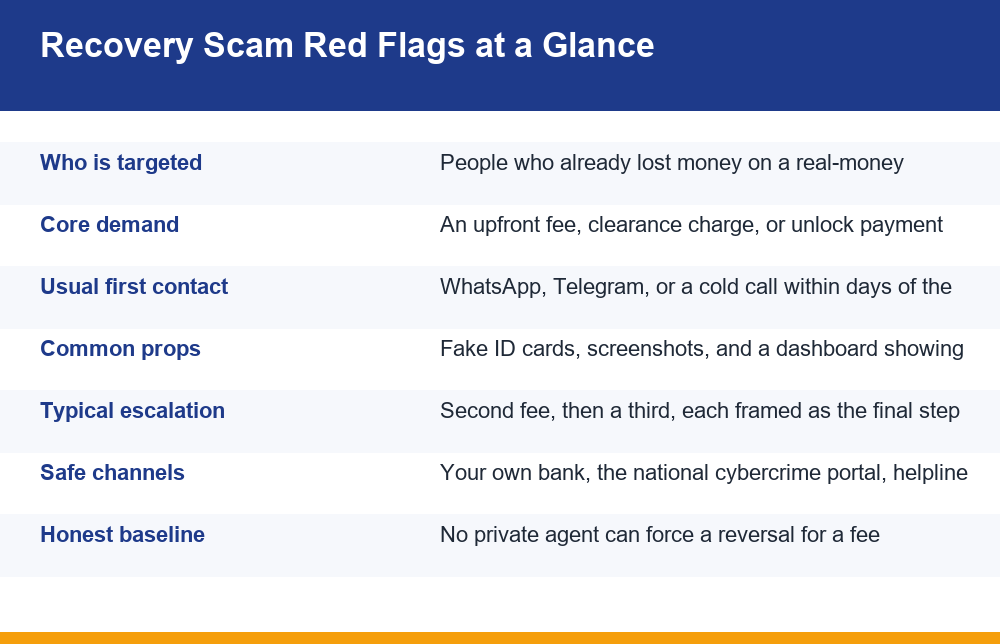
Gaming recovery scams explained: the short answer
Here is the whole thing in one paragraph, so you can stop reading and act if you need to. If someone contacts you offering to recover money you lost on a gaming app, and at any point they ask you to pay, transfer, deposit, or buy anything first, treat it as a scam. Gaming recovery scams work because the fee feels small next to the loss — a few hundred or a few thousand against the much larger amount you are trying to claw back. That asymmetry is the entire business model. The fee is not a step toward recovery; the fee is the fraud.
The second half of the short answer is just as important: the people who can genuinely help do not cold-call you, and they do not charge you. Your own bank or payment provider, the national cybercrime reporting portal, and the 24×7 financial fraud helpline on 1930 are the channels that exist for this. They are free. They are slow and procedural and they come with no guarantee, which is exactly why a confident stranger promising a result in 48 hours feels so much better. Feeling better is not the same as getting your money back.
It is worth being blunt about why this particular fraud is so effective. Anyone who has just lost money is in a specific state: embarrassed, short of sleep, replaying decisions, and desperate for a version of events where the loss was not final. A recovery offer arrives as exactly that version. It does not ask you to accept what happened; it tells you the money is still out there, still yours, and only one small step away. That is a far more comfortable story than the truth, and comfort is what is actually being sold.
Everything below is the long version — the mechanics, the scripts, the tells, and what to do with the next two days.
The re-victimisation playbook, step by step
Gaming recovery scams follow an approach consistent enough that once you have seen it described, you will recognise it immediately. It runs in five moves.
Move one: the warm open. The first message is not a pitch. It is sympathy. The sender names the app you used, sometimes the rough amount, sometimes the week. They say they are part of a recovery cell, a cyber unit, a refund desk, a fraud response team, a victims’ association. They may send a photo of an ID card, a logo, or a screenshot of a case list with other people’s names partly blurred. None of this is hard to fabricate, and all of it is designed to answer the only question you are really asking: are you real?
Move two: the proof. You get shown something that appears to confirm your money has been located. A dashboard with your amount sitting in a “held” or “frozen” or “pending release” state. A case reference number. A document with a seal on it. This is the hook, because it converts a vague hope into a specific, visible number that now feels like it belongs to you again. Notice what the proof never includes: anything you could independently check from your own side, on a channel you opened yourself.
Move three: the small ask. Now the fee appears, and it is deliberately modest and deliberately technical. A processing charge. A gateway fee. A verification deposit that will be refunded with the main amount. A clearance payment that must be settled before release. Framed this way, paying is not a risk — it is an administrative formality standing between you and a sum you can see on screen.
Move four: the escalation. You pay. Something goes wrong. The transfer bounced, the amount triggered an internal check, a senior desk needs a clearance, the window is closing in two hours. Each new fee is presented as the last one, and each is smaller than the total you are now chasing — which includes not just your original loss but every fee you have already paid. This is the sunk-cost trap, and it is the part that does the real damage. The second loss can easily end up larger than the first.
Move five: the harvest or the exit. Either the contact goes quiet, or it turns into something worse: requests for your bank login, a one-time password “to verify the account”, remote-access software “so we can complete the paperwork for you”, or a copy of your ID and a selfie. At that point you are no longer being charged fees — your account and identity are the product. If you want the wider picture of how these app-adjacent harms connect, our breakdown of the real risks attached to online gaming apps covers the surrounding ecosystem in more detail.
One structural detail is worth sitting with. At no point in those five moves does the person on the other end need any real capability. They do not need access to your bank, a relationship with the app, or the ability to move anyone’s money. The entire sequence is a conversation, and every artefact in it — the dashboard, the reference number, the sealed document, the deadline — exists only as an image on your screen. That is why the script barely changes between cases: there is nothing to change, because there was never any machinery behind it.
Gaming recovery scams: 7 warning signs after a loss
You do not need to assess each contact on its merits. These seven signals, taken individually, are each sufficient to walk away.
- They contacted you first. No genuine complaint process reaches out to you unsolicited on WhatsApp, Telegram, Instagram, or by cold call. Help responds to a complaint you filed; it does not go hunting.
- Money has to move before anything happens. A fee, a deposit, a clearance charge, a payment for a form, a small “test” transfer. Any payment in advance, in any wrapper, ends the conversation.
- There is a deadline. Two hours, end of day, before the batch closes. Urgency exists to stop you from checking, asking a family member, or sleeping on it.
- A guaranteed outcome is promised. “100% recovery”, “full refund assured”, “we have never failed”. Nobody can guarantee a reversal, because nobody controls the other side of the transaction.
- They want credentials or access. Passwords, PINs, one-time passwords, UPI PINs, card CVVs, or remote-access apps. A real process never needs any of these, and a one-time password shared is money gone.
- Payment goes somewhere a real organisation never asks for. A personal UPI ID, an individual’s account, crypto, gift vouchers, prepaid cards, or an account whose name does not match the organisation they claim to represent.
- The paperwork does not survive a second look. Fuzzy seals, mismatched names, free webmail addresses, a “portal” on a lookalike domain, officials who will not take a call on a published number you dialled yourself.
The single most useful habit here is reversing the direction of contact. Never continue on a channel someone else opened. Close it, find the official number or portal independently, and start again from your side. Scammers depend almost entirely on you staying inside the conversation they control, because every reassurance they offer only works while they are the one supplying it.
It also helps to notice what these seven signs have in common. Each one removes a check you would otherwise make: the unsolicited contact removes your choice of who to deal with, the deadline removes your time to think, the guarantee removes your scepticism, the credential request removes your last line of defence, and the fabricated paperwork removes the need for anything verifiable. You are not being persuaded by evidence. You are being moved through a sequence quickly enough that the absence of evidence never registers.
Can anyone really recover money lost on a gaming app?
This deserves an honest answer rather than a comforting one, because the honest answer is what protects you from gaming recovery scams in the first place.
It depends entirely on what kind of loss it was. If you deposited money and lost it in play, that money was spent, not stolen. There is no mechanism that reverses a loss you chose to take, and anyone saying otherwise is selling you something. If instead money left your account through fraud — an unauthorised transaction, a deposit that never credited, a withdrawal that was blocked and then vanished, a fake app that collected deposits and disappeared — then there is a genuine process, and speed matters enormously. Payment chains can sometimes be interrupted while funds are still in transit or sitting in an intermediary account. That window is usually measured in hours, not weeks.
What that means practically: the realistic path runs through your bank’s fraud desk and the official reporting channels, started as fast as possible. Outcomes vary, partial recovery is more common than full recovery, and plenty of cases end with nothing. That is an uncomfortable thing to read. It is also why the promise of certainty is such an effective lure.
There is a third category that catches people out: the loss that feels like fraud but is actually the app working as designed. A balance that shows a win and then will not release it, a withdrawal that stays “pending” while deposits clear instantly, a bonus that locks your own money behind a turnover requirement. These are frustrating and they are worth reporting, but they are not a transaction anyone can reverse on your behalf. Knowing which category you are in saves you from chasing a result that was never available — and from paying someone who claims it is.
Here is how the two things compare side by side.
| Question | A genuine process | A recovery scam |
|---|---|---|
| Who makes contact | You do, to your bank or an official portal | They do, unprompted, on a messaging app |
| Cost to you | Nothing | A fee up front, then more fees |
| Promised outcome | No guarantee given | Full recovery guaranteed |
| Timeline | Weeks, with reference numbers and slow updates | Hours or days, with constant deadlines |
| Information requested | Transaction details you already hold | Passwords, OTPs, ID copies, remote access |
| Where money is sent | Nowhere — you are not asked to pay | Personal accounts, crypto, vouchers |
| If you ask questions | Answers are dull and procedural | Pressure, flattery, or sudden hostility |
Why the advance fee always comes first
Advance-fee fraud is one of the oldest structures there is, and gaming recovery scams are simply its latest wrapper. It survives because it is efficient. The scammer needs no infrastructure, no access to your bank, and no ability to actually move anyone’s money. All they need is for a small share of contacts to pay once.
The fee also does psychological work. Paying something makes the arrangement feel real — you now have a stake, a reference number, a contact who replies. It converts you from a sceptic into a participant. And because the amount is calibrated to feel trivial against your loss, refusing feels irrational: why would you let a few hundred stand between you and tens of thousands?
There is a second reason the fee comes first rather than at the end. A fee charged on success would require success. A fee charged in advance requires only a plausible story. So when you see the sequence “pay, then we act”, you are not looking at an unusual business model. You are looking at the only model that works when nothing is ever going to be delivered.
Watch, too, for how the wrapper around the fee changes as you resist. Refuse a processing charge and it becomes a refundable deposit. Refuse that and it becomes a token amount “just to verify your account is active”. Refuse again and it becomes a request to buy a voucher instead of transferring. The specific justification is improvised; the requirement that money leaves you first never moves. That is the fixed point of the whole arrangement, and it is the only thing you need to track.
The same logic drives the deposit-and-unlock mechanics people meet inside sketchy apps themselves — the balance that shows a win but needs one more top-up to withdraw. Our write-up on how colour prediction setups keep players depositing walks through that pattern, and recognising it there makes it much easier to spot when it reappears dressed as a refund.
How scammers know you lost money in the first place
The uncanny part, for most people, is the specificity. They knew the app. They knew roughly what you lost. It feels like inside information, and that feeling is doing a lot of the persuading. The explanations behind gaming recovery scams are mundane.
- Leaked or resold user lists. Phone numbers and deposit records from poorly secured apps can end up in the wrong hands. A list of people who deposited and lost is, to a fraudster, a qualified lead list.
- Groups you joined yourself. Telegram and WhatsApp channels around prediction games, tips, or app promotions are easy places to harvest contacts. Members are known losers by definition.
- Complaints you posted in public. App store reviews, social media replies, public complaint forums, and comment sections are scraped routinely. A public post saying an app took your money is an open invitation.
- Fake help pages and support numbers. Searching for a refund can turn up planted “customer care” numbers and lookalike grievance sites that exist purely to capture distressed users. You call them, and now they have your story in your own words.
- Cold volume with guesswork. Some contacts are simply mass messages with a generic script. They name a popular app and a vague amount; the people who reply are the ones it happened to. Your reply is the confirmation, not their knowledge.
That last mechanism is the one people underestimate most, because it inverts the direction of the information. A message saying “we are handling refunds for users of a prediction app who lost money last month” costs nothing to send to thousands of numbers. Almost everyone ignores it. The handful who answer “yes, how did you know?” have just told the sender everything the sender did not know. From that point the conversation feels informed, and it was your own reply that made it so.
Two defences follow directly from this. Do not describe your loss in public with your real contact details attached, and treat any support number you did not get from an organisation’s own verified page as hostile. If the app itself is the problem, the right move is a formal complaint rather than a public vent — our step-by-step on how to report a fake gaming app properly covers what to document and in what order.
Where to actually report money lost to an online game
Three channels, in this order, and all of them free.
Your bank or payment provider first. Call the number printed on your card or shown inside your official banking app — not a number from a search result. Report the transactions as fraud, ask for them to be flagged and for the account to be secured, and get a complaint reference. If the money is still moving, this is the only step with any chance of interrupting it, which is why it comes before everything else.
The national cybercrime reporting portal second. Financial fraud complaints are filed at the official portal, the National Cyber Crime Reporting Portal, which is the government’s own channel for this and charges nothing. File it yourself, from your own device, and keep the acknowledgement.
Helpline 1930 for anything urgent. The 24×7 financial cyber fraud helpline exists precisely for the hours right after a loss, when a call is faster than a form. Calling it does not replace the written complaint; follow up with the portal filing as soon as you can.
Before you contact any of them, spend ten minutes assembling the details they will ask for: the transaction dates and amounts, the transaction IDs or UTR numbers, the bank or wallet each payment left from, the app name and where you downloaded it, and screenshots of the relevant chats and deposit history. Having that ready turns a vague account into a filing that can actually be worked on, and it stops you from having to go back and forth while the useful window closes.
Note what is absent from that list: any private agent, any paid intermediary, any “cyber expert” found through an advertisement or a message. Nobody in the real chain needs a fee from you, and the existence of a free official route is the simplest argument against every paid offer you will receive. That one fact answers almost every question people have about gaming recovery scams.
The first 48 hours: a practical checklist
Act in this order. The early hours are worth more than everything that follows, and doing these things also removes most of the openings that gaming recovery scams rely on.
- Stop all payments. No further deposits, no “one more to unlock the withdrawal”, no fee to anyone. Freeze the outflow before anything else.
- Secure the money rails. Call your bank on a verified number. Report fraud, ask for the account to be protected, change your banking and UPI credentials, and remove any saved payment method from the app.
- Capture the evidence. Screenshot the transactions, the app’s deposit and withdrawal history, the chat threads, the app listing, any URLs, and the exact dates and amounts. Note transaction IDs and UTR numbers — these are what every channel will ask for.
- Check your device. Remove any remote-access or screen-sharing app you installed because someone asked you to, revoke app permissions, and sign out of sessions you do not recognise.
- File the official complaint. Submit it yourself on the cybercrime portal and keep the acknowledgement number somewhere you can find it.
- Close the inbound channels. Block and report the contacts, leave the groups, and expect more approaches for weeks afterwards. Your number is on a list now.
- Tell one person. A spouse, sibling, or friend. The single strongest protection against a second fee is having to say it out loud to someone who is not inside the panic with you.
- Take the pressure off. If the loss is affecting your sleep, your work, or your sense of control, free and confidential support lines exist for exactly this, and using one early is not an overreaction.
If you only manage two of those eight, make them the first and the seventh. Stopping the outflow protects the money you still have, which is the only amount you genuinely control. Telling one person breaks the isolation that every follow-up approach depends on — it is far harder to pay a stranger’s “final clearance fee” at eleven at night when you know you will have to mention it to someone tomorrow.
Mistakes that make a bad week worse
A short list of the things that most reliably turn one loss into several, and most of them are exactly what gaming recovery scams feed on.
- Searching for a refund and calling the first number you find. That search result is a known trap. Only use contacts published on an organisation’s own verified page.
- Paying a fee because the amount is small. The size of the fee is the design, not a discount. Small enough to pay without thinking is the point.
- Trying to earn it back in the app. Chasing a loss is how a contained loss becomes an uncontained one. Nothing about the odds changed because you are behind.
- Treating screenshots as proof. Dashboards, seals, ID cards, and case numbers are trivially faked. Visual confidence is not verification.
- Staying in the conversation to “find out more”. Engagement is what the script is built to exploit. Leaving is free; curiosity is not.
- Waiting to see if the money comes back on its own. Delay closes the only window where interruption is possible. Report first, wonder later.
- Keeping it entirely to yourself. Secrecy is what allows a second and third payment to happen without anyone asking an obvious question.
The uncomfortable truth underneath all of this is that there is no technique, system, or intermediary that converts a loss back into a balance. No staking plan beats the margin, and no agent beats the fact that the money has already moved. What you can control is whether a single bad outcome becomes a chain of them — and that comes down to one rule, applied without exceptions: nobody who genuinely helps will ever ask you to pay first.
Frequently Asked Questions
Can anyone really recover money lost on a gaming app?
It depends on what kind of loss it was. Money you deposited and then lost in play was spent, not stolen, and there is no mechanism that reverses it. If money left your account through fraud — an unauthorised transaction, a deposit that never credited, or an app that took deposits and vanished — then a genuine process exists through your bank and the official cybercrime channels, and acting within hours matters far more than anything else. Outcomes vary, partial recovery is more common than full recovery, and some cases end with nothing. Anyone offering you a guarantee is not describing reality.
Are money recovery agents genuine or scams?
Treat any agent who contacts you unprompted and asks for payment as a scam, without exception. Gaming recovery scams are built around that exact profile: an unsolicited message, visible proof that your money has been located, and a modest fee standing between you and its release. The channels that genuinely handle this — your own bank’s fraud desk, the national cybercrime reporting portal, and helpline 1930 — do not charge you and do not come looking for you.
Why do recovery agents ask for an advance fee?
Because a fee charged on success would require actual success, while a fee charged in advance requires only a plausible story. It is the only structure that works when nothing is ever going to be delivered. The amount is deliberately small relative to your loss, so refusing feels irrational, and paying once also turns you from a sceptic into a participant with a stake — which makes the second and third fees much easier to extract.
How do scammers know I lost money on a gaming app?
Usually through mundane routes rather than inside information: leaked or resold user lists from poorly secured apps, membership of prediction or tips groups on messaging platforms, public complaints you posted on app stores or social media, planted fake ‘customer care’ numbers that capture people searching for refunds, and plain mass messaging where only the people it actually happened to reply. Your reply is often the confirmation, not their prior knowledge.
Where should I actually report money lost to an online game?
Start with your bank or payment provider, using the number printed on your card or shown in the official app, and report the transactions as fraud so they can be flagged while funds may still be moving. Then file a written complaint yourself on the National Cyber Crime Reporting Portal and keep the acknowledgement number. For anything urgent in the first hours, the 24×7 financial cyber fraud helpline on 1930 is faster than a form. All three are free, and no private agent is part of that chain.
