
Gaming habit loop: 10 proven ways to take back control
You opened the app to fill four idle minutes while the kettle boiled, and the clock now says something you do not want to read – that gap between intention and outcome is the gaming habit loop working exactly as designed. It is not a story about willpower, and it is not a moral failing. It is a short, repeatable sequence of trigger, decision, result and re-entry, each piece of it fast enough that no single step ever feels like a real choice.
Most writing on this subject is either a clinical questionnaire that tells you nothing about your Tuesday evening, or operator boilerplate that says “play responsibly” and moves on. What follows is neither: a plain description of the loop itself, then the specific interruption that fits each stage, the mistakes that waste months, and an honest note about the point where self-help stops being the right tool. One line of context before any of it: real-money play is for adults only, losses are the expected outcome rather than bad luck, and no pattern-reading changes that.
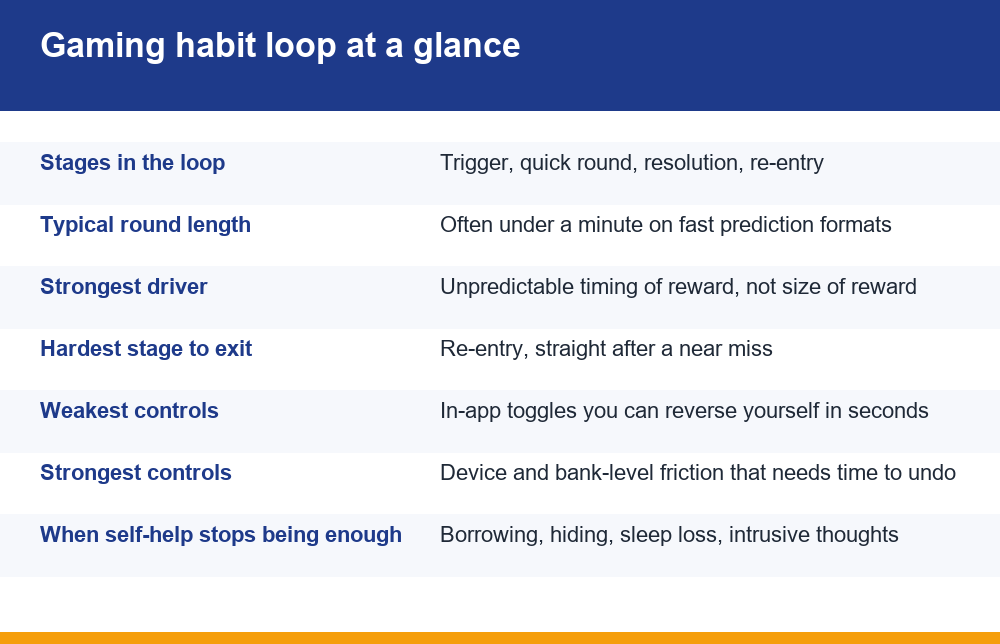
What the gaming habit loop actually looks like
Habits are usually described as a three-part cycle: a cue, a behaviour, and a reward. Fast real-money formats add a fourth element that matters more than the other three combined – a resolution that is often ambiguous, followed by an immediate chance to go again. That fourth element is what turns a habit into a gaming habit loop rather than an ordinary routine. You never reach a natural stopping point, because the format is built so that the end of one round is also the start of the next.
Breaking the sequence into named stages is useful for one practical reason: each stage responds to a completely different interruption. Trying to use a single tactic across all four is why most attempts to cut back collapse within a week. A phone-in-a-drawer rule is excellent at the trigger stage and useless at re-entry, because by re-entry the phone is already in your hand.
| Stage | What happens | Why it holds you |
|---|---|---|
| Trigger | A cue appears: boredom, a notification, the end of a shift, a difficult conversation, a specific chair at a specific hour | The cue does the deciding before conscious thought arrives |
| Quick round | A simple choice between two or three options, resolved in well under a minute | The speed makes it feel like skill and judgement, not chance |
| Resolution | A win, a loss, or the most powerful outcome of all – an almost | Ambiguous results sustain motivation instead of ending it |
| Re-entry | The next round is already open, with the stake pre-filled | There is no gap in which a decision to stop could be made |
Read down that table and notice how little of it is about money. The stake size barely features. What features is timing, ambiguity and the absence of any pause. This is why two people losing identical amounts can have completely different experiences: the one playing a small number of slow rounds is not inside the same loop as the one playing two hundred fast ones.
It is also worth being precise about what the word loop is doing here. A loop is not the same thing as a craving. Cravings are loud and you can argue with them; a gaming habit loop is quiet, and the reason it is hard to stop is that there is nothing to argue with. Each individual step is small, reasonable and almost free. One more round costs very little. Opening the app for four minutes costs nothing at all. The damage is entirely in the repetition, and repetition is exactly the thing that in-the-moment reasoning is worst at seeing.
That is why the rest of this breakdown is organised around structure rather than resolve: you are not trying to win an argument with yourself, you are trying to put something physical in the path of a sequence that runs faster than argument.
What keeps people coming back to colour prediction rounds
Behavioural research has been consistent on this point for decades: a reward that arrives on an unpredictable schedule produces far more persistent behaviour than one that arrives reliably. If a vending machine gave you a snack every single time, you would use it when hungry and ignore it otherwise. If it gave you a snack on an unpredictable fraction of attempts, you would press the button far more often than hunger justifies. Colour prediction formats sit squarely in the second category, and so does almost every fast real-money round.
Three further features stack on top of that base mechanism.
- A choice small enough to feel like a judgement. Picking between two or three colours does not feel like buying a lottery ticket. It feels like an opinion you are backing. That framing converts a chance event into something your mind files as a decision you can get better at.
- A visible history strip. Showing the last twenty results is one of the most consequential design choices in these formats. Human beings are relentless pattern detectors, and a run of identical results reads as information. It is not information. Each round is resolved independently, and the previous twenty have no bearing on the next one.
- Asymmetric social proof. In groups and channels built around these formats, wins are posted and losses are silent. You are shown a filtered sample and your sense of what is normal shifts accordingly. Nobody screenshots a quiet hour of steady decline.
There is a fourth feature that gets less attention: the absence of any natural unit of play. A film is roughly two hours. A cricket match has an end. A fast round has no unit at all, so the only available unit is the one you invent, and an invented unit decided while you are inside the loop is reliably generous. People do not sit down planning to play for ninety minutes. They sit down planning to play for a bit, and a bit is not a quantity.
There is a further layer worth naming, because it is where real money disappears fastest. Around these formats sits an ecosystem of paid prediction groups, “guaranteed” signal sellers, and recovery offers aimed at people who have already lost. If you have been approached by any of these, it is worth reading how the standard colour prediction scam patterns are structured and spotted, because the pitch is almost always built on the same loop described here – it targets you at the moment you most want the last round back.
None of this requires anyone to be gullible. The mechanism works on people who fully understand it. Knowing that a history strip is noise does not stop your visual system from seeing a run, and that is the whole point.
Why it is so hard to stop after a near miss
The near miss is the most underexplained part of the whole subject, and it is the hinge on which the gaming habit loop turns. A near miss is an outcome that failed, but failed narrowly and visibly – the result that was one step from yours, the round that resolved against you at the last moment, the sequence that would have paid if you had held your previous choice.
Logically, a near miss is a loss. It costs exactly what any other loss costs. Behaviourally it does something very different: instead of reducing the urge to continue, it tends to increase it. The outcome is close enough to a win that it registers as progress, as evidence of being nearly right, as a sign that the next attempt sits within reach. A clean loss is an ending. An almost is an unfinished sentence, and unfinished things nag.
Two things compound this. The first is that an almost feels like feedback on your judgement, which strengthens the belief that judgement is involved at all. The second is loss chasing. Once a balance has fallen, the number on screen stops being money you spent and becomes a target to be restored. That reframing is quietly enormous. Spending is something you weigh against alternatives; restoring is something you simply continue until it is done. Except the margin means it does not get done, on average, and an honest reading of the format starts from the fact that the expected outcome over time is a loss, not a return to the starting balance.
It is worth noticing how asymmetrically memory treats these moments. Weeks later, people can describe their near misses in detail and cannot describe their ordinary losses at all, because the ordinary ones carried no story. The result is a private highlight reel that is nothing like the real record, and a sense of having been close that no ledger would support. If you ever want a corrective, the ledger is the corrective: the total for the month is the honest version, and your recollection is the edited one.
The practical consequence: the near miss is the worst possible moment to rely on an in-the-moment decision to stop. Any limit that depends on you choosing well immediately after an almost is a limit built on the least reliable moment you have. This is why the useful interruptions all get installed earlier, when nothing is at stake.
How short round times change behaviour
Round length is the variable people pay least attention to and the one that changes outcomes most. A format resolved in under a minute behaves nothing like one resolved in ten minutes, even at identical stakes, because of what the compressed cycle removes.
- The reflection gap. Deliberate thought needs a few seconds of dead air to get started. When the result and the next opportunity arrive in the same breath, the reflective part of your mind never gets a turn – the loop runs on the fast, automatic system alone.
- Any sense of session boundaries. With slow formats there is a natural end: the event finishes, the evening finishes. Fast rounds have no edges, so the session ends only when something external interrupts it.
- Accurate accounting. Money handled in many small increments does not register the way the same money registers in one piece. Twenty stakes of fifty do not feel like a thousand. They feel like fifty, twenty times.
- A realistic sense of elapsed time. Short, repeating cycles with variable outcomes are unusually good at compressing subjective time. Ninety minutes genuinely feels like fifteen, and people are not exaggerating when they say so.
The useful number to track is therefore not your stake but your decisions per hour. At one round a minute, an hour is sixty separate commitments of money. That figure is the real driver of total exposure, and it is also the figure that makes the whole thing exhausting in a way that is easy to mistake for ordinary tiredness. If you want one metric to write down for a week, write that one down rather than the amount.
The same arithmetic explains why small stakes are not automatically safe, which is a point almost every version of this conversation misses. A tiny stake repeated at high frequency can move more money in an evening than a large stake placed once, and it does so while feeling careful the entire time. Frequency, not size, is where the exposure lives. If you are going to set one boundary and only one, a boundary on rounds or on minutes does more work than a boundary on amount, because the amount is a downstream consequence of the other two.
Ten ways to interrupt the gaming habit loop
These are ordered roughly by where they bite. The principle throughout is the same: place the effort at a calm moment so that the loop runs into it at a difficult moment. Every item that depends on deciding well mid-session has been deliberately left out, because that is the one thing a gaming habit loop is specifically built to defeat.
- Write down the trigger, not the session. For one week, log a single line each time you open the app – where you were, what had just happened, what time it was. Most people find three or four recurring cues, not twenty. Cues you can name are cues you can plan around.
- Add friction before the first round. Off the home screen, out of the app switcher, logged out, notifications off. The goal is not to make access impossible. It is to insert four or five seconds of deliberate action where there were none.
- Separate the money from the device. Remove saved cards and stored payment methods, and switch off anything that tops up automatically. Needing to fetch a card is a small barrier at a calm moment and a large one at re-entry.
- Set a time alarm outside the app. An in-app clock is inside the system you are trying to leave. A kitchen timer or a phone alarm in another room is a signal from outside it, and outside signals carry more weight.
- Decide the exit before the entry. Written down, in advance, in plain terms: what will make this stop, including what will make it stop while things are going well. An exit condition decided afterwards is not an exit condition.
- Break re-entry by changing your body. Stand up, leave the room, move to a different chair. Re-entry depends heavily on continuity of posture and place. Interrupting the physical setup interrupts more of the loop than it has any right to.
- Fill the slot rather than emptying it. A habit occupying a specific time window needs a replacement for that window, not a prohibition. If the trigger is the end of a shift, the end of the shift needs something else in it.
- Make the thirty-day total visible. The loop survives on per-session accounting, where every evening is independent and roughly break-even. A monthly figure, written somewhere you will see it, removes that defence. It is uncomfortable and it works.
- Tell one person. Not an announcement – one person who knows what you are changing. Secrecy is load-bearing for this pattern, and removing it costs the loop more than any app setting.
- Mute the supply of wins. Leave the groups and channels. The filtered sample of other people’s results is a continuous trigger that you cannot argue with while you are still receiving it.
Two notes on using this list. First, do not attempt all ten. Three that survive a bad week beat ten that collapse on day four, and the three worth keeping are the ones aimed at your own recurring cues rather than at the idea of the habit in general. Second, install them in the order the loop runs: trigger first, re-entry second, everything else afterwards. The stages nearest the start are the cheapest to block, because nothing is at stake yet.
If you want the broader framework these sit inside – budgeting as a cost rather than an investment, time boundaries, and the difference between a limit and a rule – our overview of practical safeguards for real-money gaming habits covers it in more detail than fits here.
Do app-side limits and breaks actually help
Partly, and the part matters. A limit is only as strong as the effort required to reverse it, so the honest answer is that in-app controls are the weakest tier available and the tier most people try first.
The reasoning is straightforward. A deposit cap you can raise from inside the same session, with two taps and no waiting period, is not a control – it is a speed bump placed on the one road you are already driving down fast. Compare that with a block applied at the device or bank level, where undoing it takes a different app, a different login, and often a delay. The delay is the active ingredient. Anything that forces a gap between wanting and doing is doing real work; anything instantly reversible is not.
| Control | How hard to reverse | Stage it affects |
|---|---|---|
| In-app deposit cap | Seconds, same session | Mildly slows the quick round |
| In-app reality check or reminder | Dismissed instantly | Weak signal at re-entry |
| Cooling-off period with enforced delay | Hours to days | Blocks re-entry effectively |
| Removing stored payment methods | Minutes, needs the physical card | Trigger and re-entry |
| Device-level app blocking | Needs another app and a passcode | Trigger |
| Bank or card gambling block | Often a fixed waiting period | Trigger and quick round |
| Formal self-exclusion | Cannot be undone on impulse | Removes the loop entirely |
Read top to bottom and the pattern is clear: effectiveness tracks irreversibility, almost perfectly. The controls that feel most comfortable to set up are the ones that do least. If you have reached the point of wanting the strongest tier, the process is more involved than flipping a switch and worth understanding properly before starting – we have set out how self-exclusion from gaming apps works in practice, including what it does and does not cover.
There is also a design point hiding in that table. Every control in the weak tier lives inside the same app as the gaming habit loop itself, which means it is available to you at precisely the moment you are least able to use it well. Every control in the strong tier lives somewhere else – another app, another institution, another person – and that separation is most of what makes it work. When you are choosing between options, the useful question is not how strict it sounds but where it lives.
One caution about breaks specifically. A short break with no plan attached often functions as a pause rather than a change, and the return can be sharper than the period before it, because the interruption built up rather than reduced the urge. A break is useful when something is installed during it. On its own it is just a gap.
Six mistakes people make when cutting back
Most attempts to step back from a gaming habit loop do not fail because the person was not serious. They fail for a small number of repeated, predictable reasons, and all six below are fixable once named.
- Relying on a rule that must be obeyed mid-session. Any plan whose critical moment arrives while you are inside the loop is being tested at the worst possible time. Move the critical moment earlier.
- Measuring the wrong thing. Counting net position rather than rounds, minutes or monthly total keeps every session looking roughly even. Net position is the one number the loop can always make look acceptable.
- Treating a quiet week as the problem being solved. A week without play while every trigger and payment route is still in place is not progress, it is a gap. Progress is structural: something is harder now than it was.
- Removing the behaviour without replacing the time. An empty slot at the same hour, in the same chair, with the same cue, is a standing invitation. The slot needs an occupant, not a ban.
- Keeping it private. Concealment is not a side effect of the pattern, it is part of its machinery. Nothing in a self-help list substitutes for one person knowing what you are doing.
- Waiting for a bad enough reason to ask for help. Free, confidential services have no severity threshold, and the month you spend qualifying for them is a month spent inside the loop.
The common thread is that five of the six are about structure and one is about secrecy, and none of them are about trying harder. If an attempt has already failed once or twice, the useful question is not what was wrong with your resolve but which stage of the sequence went unguarded.
An honest self-check, stage by stage
This is not a diagnostic instrument and it does not produce a score. It is a set of questions designed to map your own version of the gaming habit loop, because the generic description above is only useful once you can see your specific cues and your specific re-entry pattern in it. Answer them in writing. Answers held in your head get edited.
- What was happening in the ten minutes before I opened it, the last three times?
- Do I know, to within a reasonable margin, what the last thirty days cost? If not, why not?
- What time does it usually start, and what usually ends it – a decision, or an external interruption?
- After a near miss, what do I tell myself about the next round? Write the sentence down verbatim.
- Have I played longer than intended more than twice in the last two weeks?
- Have I played in order to feel better about something unrelated?
- Is there anything about the amount or frequency that I have not mentioned to anyone?
- Have I borrowed, moved money between accounts, or delayed a bill in order to continue?
- If someone described my last month back to me in neutral terms, would I be comfortable hearing it?
The last two questions carry more weight than the rest. Borrowing and concealment are the two markers that reliably indicate a pattern has stopped being self-contained, and neither of them is addressed by any of the ten interruptions above. They are the point at which the subject changes from habit management to something that needs another person involved.
When self-help is the wrong tool
Self-directed interruptions work well for a specific situation: a habit that has grown larger than you intended, with no serious financial or emotional damage attached, and with your own motivation to change still intact. That describes a lot of people and there is no reason to escalate beyond it unnecessarily.
It is the wrong tool, and continuing to reach for it costs real time, when any of the following are true.
- Money is being borrowed, or moved from somewhere it was needed, in order to keep going.
- The amount or the frequency is being actively hidden from people close to you.
- Sleep, work or study is being affected consistently rather than occasionally.
- Thoughts about rounds, results or recovering losses intrude when you are not playing.
- You have set the same limit more than twice and reversed it each time.
- There is persistent low mood, anxiety or hopelessness attached to it – and especially any thought of self-harm, which needs same-day human contact and not a checklist.
None of those indicate anything about your character. They indicate that the thing has moved outside the range a self-administered plan can reach, in the same way a persistent infection moves outside the range of rest and fluids. Free, confidential, non-commercial help exists for precisely this, and it does not require you to have hit any particular threshold of severity before you are allowed to use it.
In India, Tele-MANAS is the Ministry of Health and Family Welfare’s free national mental health helpline, reachable on 14416 and operating around the clock in multiple languages. For free online support that is not tied to any operator, the charity-run Gambling Therapy service offers moderated forums, one-to-one text chat and online groups – its own page explaining what the free global Gambling Therapy service provides sets out who staffs it and how it is funded. Anonymous options are available if speaking to someone you know is not realistic right now.
The single most useful reframe to end on: this is a sequence, and sequences have seams. You do not have to overpower the whole thing at once. You have to find the one seam in your version of it – usually the trigger or the re-entry – and put something immovable there while you are calm, so that the loop runs into it when you are not.
Frequently Asked Questions
What keeps people coming back to colour prediction rounds?
Mostly the unpredictable timing of the reward. Behaviour reinforced on an irregular schedule persists far longer than behaviour rewarded reliably, which is why an unpredictable payoff produces more repetition than a guaranteed one. On top of that sits a choice simple enough to feel like a judgement rather than chance, a visible history strip that your pattern-detecting brain reads as information when each round is actually resolved independently, and group chatter where wins are posted and losses stay silent. Understanding the mechanism does not switch it off, which is why structural changes work better than resolve.
Why is it so hard to stop after a near miss?
Because a near miss behaves like partial progress rather than a loss. Financially it costs the same as any other loss, but it registers as having been nearly right, which sustains motivation instead of ending it. An almost also leaves a sense of something unfinished, and unfinished things pull. Added to that is loss chasing: once the balance drops, the number stops being money spent and becomes a target to restore, which turns stopping into abandoning rather than concluding. The practical lesson is that the moment after a near miss is the worst possible time to rely on an in-the-moment decision.
How do short round times change behaviour?
They remove the pause that deliberate thought needs. When the result and the next opportunity arrive in the same second, only the fast, automatic part of the mind is involved. Short cycles also erase session boundaries, so nothing ends the session except an outside interruption, and they break accounting – twenty small stakes do not register the way the same total registers in one piece. They compress subjective time as well, so ninety minutes honestly feels like fifteen. The number worth tracking is decisions per hour, not stake size.
What practical steps interrupt the loop?
Install them at calm moments, not mid-session. Log your triggers for a week to find the three or four recurring cues; add real friction before the first round by logging out and removing the app from easy reach; remove stored payment methods; set a time alarm outside the app; write your exit condition before you start; break re-entry by standing up and changing room; put something else in the time slot rather than just banning it; make the thirty-day total visible instead of judging each session separately; tell one person; and leave the groups that supply a filtered stream of other people’s wins. Three that survive a bad week beat ten that collapse on day four.
Do app-side limits and breaks actually help?
Some do, and effectiveness tracks how hard the control is to reverse. A deposit cap you can raise in two taps during the same session achieves very little. A cooling-off period with an enforced delay, a device-level block needing a separate passcode, or a bank-level block with a waiting period all work, because the delay itself is the active ingredient. The weak controls also live inside the same app you are trying to step away from, while the strong ones live somewhere else. Breaks help only when something is installed during them – an unplanned pause often builds the urge rather than reducing it.
When should someone ask for free professional support?
When money is being borrowed or diverted to keep going, when the amount or frequency is being hidden from people close to you, when sleep, work or study is consistently affected, when thoughts about results or recovering losses intrude during ordinary life, or when you have set and reversed the same limit repeatedly. Persistent low mood, anxiety or any thought of self-harm needs same-day human contact rather than a self-help plan. None of these say anything about your character; they indicate the pattern has moved beyond what a self-administered plan can reach. Free, confidential, non-commercial helplines exist and have no severity threshold.
