
Loss limits for gaming – 7 Smart Steps to Protect Your Money
Most articles about loss limits for gaming get one thing badly wrong: they treat the limit as a setting rather than a decision about household money. Type a number into a toggle, the story goes, and the problem is handled. In practice a limit that lives only inside an app you are emotionally invested in is the weakest kind of limit there is, because it can be raised in the same minute it is reached, by the same person, in the same mood.
A limit that actually holds is written down somewhere outside the app, sized against money you have already decided you can lose, and backed by one or two controls on the payment side that take real time and effort to undo. This breakdown walks through how to choose the number, how to record it, how to support it at the bank, and what to do in the specific minute it is reached. It contains no tips, systems or predictions, because none exist; over time, losses are the expected outcome of real-money play. The question is not how to avoid that outcome but how to fix its size in advance. Real-money play is for adults 18+ and carries financial risk.
What Most Pages on This Topic Get Wrong
The common framing is that a limit is a feature. You find the setting, you enter a figure, and responsibility has been discharged. That framing is comfortable for everyone except the person using it, because it skips the only part that is difficult: deciding, in advance and in cold blood, how much money you are prepared to never see again this month.
The second mistake is abstraction. A great many pages say “only play with what you can afford to lose” and then stop, which is advice shaped like a sentence rather than a method. Afford to lose compared with what? Measured over what period? Checked against which account? Without answers, the phrase becomes a mood rather than a number, and a mood adjusts itself upward on a bad evening.
The third mistake is confusing a loss limit with a deposit limit and using the words interchangeably. They are different instruments with different blind spots, and understanding the difference is the first piece of real work. A deposit cap controls what enters an account. A loss limit controls the net outcome you are willing to accept. Money that re-enters play after a win is not a fresh deposit, but it is very much still your money, and a deposit cap alone will not notice it leaving.
A fourth and subtler problem is that most advice is written as though the decision happens once. It does not. A limit is tested every time the balance runs low, and each test arrives with a slightly better argument than the last. Treating the limit as a one-off configuration step rather than a standing arrangement that needs support is why so many carefully chosen figures quietly stop describing anything real within two months.
Finally, almost nobody writes about the moment that decides whether any of this worked, which is the minute the limit is reached. That minute is short, loud and persuasive, and a plan written down in advance for that minute is worth more than every other paragraph on this page.
What Is a Loss Limit in Online Gaming?
A loss limit is a pre-set ceiling on net money lost over a defined period. Net is the operative word: it counts what you put in minus what you take out, so a win that is immediately played back does not quietly reset the clock. If you deposited 3,000 over a month, withdrew 800, and the rest is gone, your net loss is 2,200 regardless of how many individual sessions ended up or down.
That is distinct from the other caps you will encounter, and the distinction matters because each one leaves a different gap. The table below lays out the four you are most likely to meet and what each one fails to catch on its own.
| Limit type | What it caps | Where it is usually set | What it misses |
|---|---|---|---|
| Loss limit | Net money lost in a period | Account settings, or by you on paper | Time spent, and spending across other accounts |
| Deposit limit | Money moved in per day, week or month | Account settings, bank-side caps | Winnings replayed without a new deposit |
| Session or time limit | Minutes or hours of continuous play | Account settings, phone screen-time tools | Money entirely; a short session can be an expensive one |
| Wager or stake limit | Size of each individual stake | Account settings, where offered | Total exposure, since small stakes repeated add up fast |
Used together, a loss limit and a deposit limit cover most of each other’s blind spots: one watches the net outcome, the other restricts the pipe. Used alone, each is easy to walk around. This layering idea sits at the centre of most sensible habits around real-money gaming, and it is the reason this page keeps returning to the phrase “backed by” rather than “set to”.
The period you choose matters as much as the figure. A daily ceiling sounds strict and behaves loosely, because thirty strict days in a row still add up to an unplanned month. A monthly ceiling is the smallest unit that lines up with how household money actually works: rent, salary, bills and savings all move on a monthly rhythm, so a monthly loss figure can be checked against a monthly statement without any arithmetic.
One more definitional point. A loss limit is not a target. It is not a budget you are expected to use up, and reaching it is not an achievement or a milestone. If a month ends with the limit untouched, nothing has been wasted. The limit is a ceiling, and a ceiling you never touch is a ceiling doing its job.
How Much Should Your Gaming Loss Limit Be?
Start from the bottom of your household budget rather than the top. Work out your monthly income, subtract the non-negotiables such as rent or EMI, utilities, groceries, transport, insurance, school fees and medicines, then subtract planned savings and any debt repayment above the minimum. Whatever is genuinely left over is discretionary money. A gaming loss limit can only come from that remainder, and it should take only a share of it, because that remainder also has to cover everything else you enjoy.
Then apply a single test, honestly. If this entire amount disappeared by the 8th of the month and you had to get to the 30th without it, would anything in your life change? Would a bill slip, a borrowing happen, a plan get cancelled, or a conversation have to be avoided? If the answer is yes to any of those, the number is too high. Reduce it until the answer is no.
A few further calibration rules keep the figure honest:
- Set it monthly, not per session. Per-session limits are the easiest kind to break, because there is always another session. A monthly ceiling has no such escape hatch.
- Zero is a legitimate answer. If there is no discretionary remainder, or if the honest answer to the test above is “yes, things would change”, then the correct limit this month is nothing at all.
- Pick a round, memorable number. A figure you can recall without opening an app is a figure you can enforce in a noisy moment. Precision here buys you nothing.
- Never size the limit against an expected win. Limits are built on what you can lose. Treating a hoped-for return as part of the maths is how a ceiling turns into a floor.
- Do not index it to income increases. A raise is a reason to save more, not to raise the ceiling. A limit that grows automatically is not a limit, it is a percentage.
If the budgeting step itself is the hard part, free non-commercial material exists for exactly that. GambleAware, a UK charity, publishes a page on budgeting and spending control that walks through calculating essential expenses, setting spending limits before playing, and asking a bank about blocking gambling transactions. Its own support services are available only to Great Britain residents, but the budgeting method on the page is not country-specific and is free to read. Working out the household number first and the gaming number second is the right order, and it is the order most pages skip.
A last point on sizing. The figure that does the most work is usually smaller than the one that feels reasonable, because “reasonable” is calculated against a good month. Size it against a difficult month instead: the month with an unexpected medical bill, a delayed payment, or a family expense you did not plan. A ceiling that survives a difficult month is a ceiling, and one that only survives an easy month is a forecast.
Seven Steps to Set Loss Limits for Gaming That Hold
The steps below are deliberately ordered. Each one makes the next harder to undo, which is the whole mechanism. You are not relying on willpower in the moment; you are spending a calm hour now so that the loud minute later has fewer options available to it.
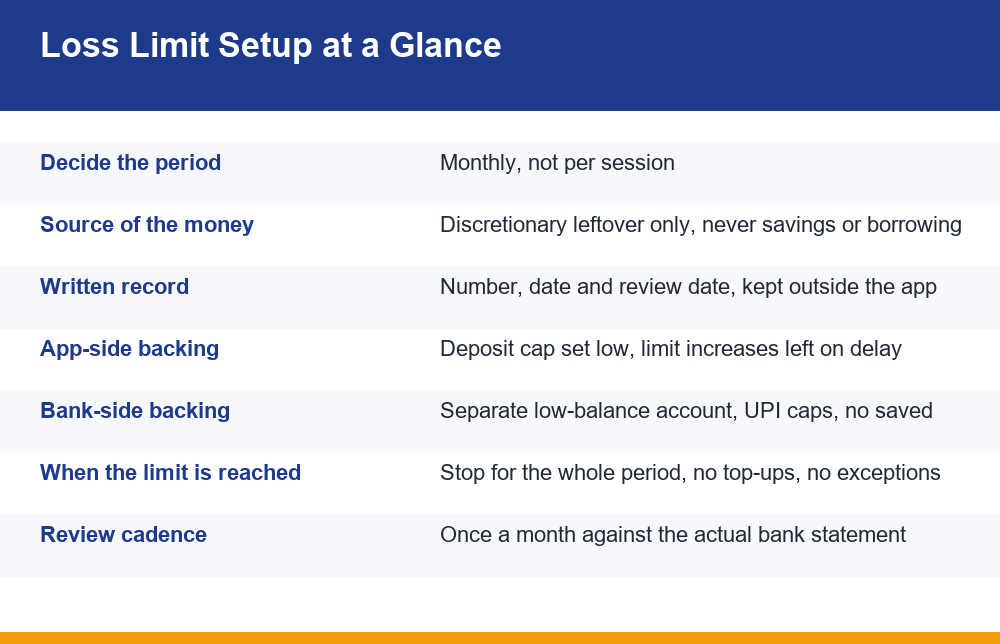
- Do the budget subtraction first. Write out income, essentials, savings and debt, and find the discretionary remainder. Do this on paper or in a notes app, not in your head.
- Choose one monthly net-loss figure from a share of that remainder, and apply the 8th-of-the-month test. Lower it until it passes.
- Write it down outside the app with the number, today’s date, and the date you will review it. A note on the fridge, a line in a notebook, a shared note with a partner. The point is that it exists somewhere the app cannot edit.
- Set the in-app deposit cap at or below that figure if the tool is offered. This is support for the written limit, not a replacement for it.
- Move the money side onto a separate low-balance account with no overdraft, no linked credit, and only the limit amount in it for the month.
- Add the payment-side controls: UPI per-transaction and daily caps, no saved cards, no autopay mandates, instant alerts on every debit. These are covered in detail further down.
- Write the stop plan before you need it. A single sentence: “When the account hits zero, I close the app for the rest of the month and I do not add money.” Read it once now so you recognise it later.
None of these steps is clever and none of them is a system. They are friction. The reason loss limits for gaming fail is almost never that the number was wrong; it is that nothing stood between the decision to exceed it and the ability to exceed it. Each step above inserts a small delay or a small obstacle, and delays are what the loud minute cannot easily get past.
Expect the whole setup to take under an hour, and expect the bank-side steps to be the ones you are tempted to skip. They are the ones that do the most work, precisely because they sit outside the environment where the pressure is applied. If you only have time for two steps this week, make them the written figure and the separate account.
Deposit Caps and In-App Tools: What They Do and Don’t Do
In-app limit tools are genuinely useful and genuinely insufficient, and it is worth being precise about both halves. On the useful side, a deposit cap set low creates a hard stop inside the environment where the decision gets made, which is the right place for a stop to exist. Cooling-off options, reality-check pop-ups and account time-outs all add delay in the same place.
On the insufficient side, there are four known weak points:
- Limit increases. Lowering a cap often takes effect at once, while raising it may or may not be delayed. Where a delay is offered, leave it switched on. A cap that can be raised instantly is a suggestion.
- Replayed winnings. A deposit cap counts money entering the account. Money already inside it, including winnings, can cycle indefinitely without the cap noticing.
- Multiple accounts. A per-account cap is only ever a per-account cap. Spending split across several apps is the single most common way a carefully chosen figure turns out to be fiction.
- Promotional top-ups and bonus balances. Credits, cashback and gift-code balances are frequently described as free. They are not a separate economy. They pull play time and attention, and the money that chases them afterwards is ordinary money. Treat any mechanic that rewards you for depositing more as a reason to be more careful, not less.
A useful way to judge any in-app tool is to ask how long it takes to undo. A cap that takes a week to loosen is doing something. A cap that loosens the instant you tap a confirmation is mostly decorative, because the person tapping it is the same person the cap was meant to restrain. Rank the tools you have by undo time and lean on the slow ones.
Two practical habits make these tools more reliable. First, screenshot every limit you set, with the date visible, and keep the screenshots in one folder. If a cap is ever not applied as expected, your own record is the only evidence you will have. Second, set limits at a calm time of day and never immediately after a session, in either direction. The figure chosen right after a loss and the figure chosen right after a win are both unreliable, and for the same reason.
If you have reached the point where the honest answer is that no cap is going to be low enough, the tool you want is not a limit at all. Account closure and blocking your own access to gaming apps are a different category of control, and choosing them is not a failure of limit-setting. It is limit-setting arriving at the correct conclusion.
Bank-Side Controls: Separate Account, UPI Caps and Payment Blocks
This is the half of the subject that most pages omit, and it is the half that does not depend on any platform cooperating. Controls you set at your own bank sit outside the app entirely, which means changing them requires leaving the environment that is applying the pressure. That is exactly the delay you are trying to buy.
The single most effective arrangement is a dedicated low-balance account. Open or repurpose a basic savings account, keep no overdraft facility and no linked credit on it, transfer in only the month’s limit amount, and use nothing else for play. The balance becomes the limit. There is no arithmetic to do and no toggle to raise. When it reads zero, the month is over, and the only way around it is a deliberate transfer from another account, which is precisely the decision you want to be slow and visible.
Layer these on top:
- UPI transaction caps. Most banking apps let you set a per-transaction and a daily limit on UPI. Set both low on the dedicated account. Small caps mean repeated, visible, annoying actions rather than one invisible one.
- Remove saved cards and tokens. Delete stored card details from any app and decline offers to save them again. Re-entering details each time is friction, and friction is the product.
- Cancel autopay and e-mandates. Check the mandates section of your banking and UPI apps and cancel anything recurring that relates to gaming top-ups. Recurring debits are the easiest spending to stop noticing.
- Switch off international, online or contactless use on the card tied to that account if you are not using it for anything else. Bank card-control screens usually make this a two-tap change.
- Turn on instant alerts for every debit, at any amount. Alerts do not block anything, but they make the running total visible in real time instead of at month end.
- Keep credit entirely out of the picture. No credit cards, no pay-later facilities, no loan apps, and no borrowing from family framed as a short-term thing. A loss limit funded by credit is not a limit; it is a deferred larger loss.
Some banks and payment providers offer merchant-category or gambling-transaction blocks. Availability varies and the categorisation is imperfect, so treat such a block as one more layer rather than a guarantee. Ask your bank directly what is available on your account type instead of relying on a general claim found online, and keep your own alerts switched on either way.
One caution about the dedicated account: do not let it become a second wallet that gets topped up casually. Set one transfer, at one fixed date each month, ideally on the day your salary arrives and before anything else is allocated. If you find yourself making a second transfer in the same month, that transfer is the signal, not the shortfall. Write it in the same note where the limit lives, with the date, so the pattern is visible at review time rather than invisible.
What to Do the Moment You Hit Your Limit
Write this part down in advance, because you will not be in a position to reason it out when it applies. The moment is characterised by a specific, recognisable feeling: that the limit was arbitrary, that the next few minutes are somehow different from the previous few, and that a small top-up is not really a breach. Every one of those thoughts is predictable, and recognising them as predictable is most of the defence.
The plan is four sentences long:
- Stop for the remainder of the period. Not for an hour, not until the balance is topped up. The limit was monthly, so the stop is monthly.
- Add no money from any source. No transfer from another account, no card, no credit, no borrowing. This is the only rule that actually matters.
- Close the app and put the phone down for twenty-four hours. The urge to continue is time-limited in a way that does not feel true while it is happening.
- Tell one person the number. Saying “I hit my limit and I’ve stopped” out loud to a partner, sibling or friend converts a private decision into an accountable one.
It helps to decide in advance what the next hour contains, because an empty hour is the easiest one to fill by reopening the app. Something with a clear end point and another person in it works best: a walk, a call, a meal, an errand. This is not a motivational flourish. The decision you are trying to survive is a short one, and filling the short interval is a practical way to get past it.
If stopping does not happen, whether because the money goes in anyway or because this is the third month in a row that the limit has been passed, that is useful information rather than a verdict. It indicates the limit is not the right tool on its own, and that free, confidential support is the appropriate next step. Helplines such as Tele-MANAS in India, and non-commercial services including GamCare and Gambling Therapy, exist for exactly this conversation, cost nothing, and do not require you to have reached any particular point of crisis first.
One honesty note belongs here. A limit does not improve your odds, shorten a losing run, or make anything “due”. Nothing does; the margin is built in and no staking pattern or arrangement of bets changes it. The only thing a loss limit protects is the size of what you lose, and that is a worthwhile thing to protect on its own terms.
Mistakes That Quietly Break a Limit
Limits rarely collapse dramatically. They erode through small, reasonable-sounding adjustments, each of which seems minor at the time and none of which feels like the moment the limit stopped working. These are the ones worth watching for.
- Rolling unused limit forward. “I only used half last month, so I have double this month.” A ceiling does not accumulate. Unused headroom is money saved, not credit earned.
- Counting a win as new budget. Winnings are your money. Replaying them because they feel like someone else’s is the fastest route past a net-loss figure.
- Limiting one app while using three. The number only means something if it covers total spending across every account.
- Treating bonus balances as outside the limit. Anything that pulls time and attention belongs inside the accounting, and the deposits that chase it certainly do.
- Raising the limit during a session. The figure chosen mid-session is not a budget decision. Any change belongs at a scheduled review, on a calm day.
- Keeping the number only in your head. An unwritten limit edits itself silently and you will not notice it happening.
- Funding play from a joint or household account. This converts a personal limit into a shared risk, and it removes the visibility that makes the limit work.
- Chasing a loss back to the limit. Trying to recover to break even is the behaviour the limit was specifically designed to interrupt.
- Counting in sessions instead of rupees. “Only two games” is not a limit. Time and money are different quantities, and a short session can be the most expensive one of the month.
Most of these are variations on one theme: redefining what counts. A limit survives only as long as its definition stays fixed, and almost every failure above is a quiet renegotiation of the definition rather than an open breach of the number. Writing the figure down with a date is not bureaucracy. It is the thing that stops the definition drifting while you are not watching.
Reviewing the Number: Signs It Is No Longer Real
Review once a month, on a fixed date, against your actual bank statement rather than against memory or an in-app summary. Export or open the statement for the dedicated account, add up every debit that relates to play, and compare the total with the written figure. The statement is the only source that cannot be edited by mood.
Expect the first review to be uncomfortable. The gap between remembered and actual spending is usually larger than people assume, and small repeated transactions are the main reason, since each one is individually forgettable and the total is not. Working through where gaming money quietly disappears each month alongside the statement makes that gap visible rather than theoretical, which is the point of doing it at all.
Certain signals mean the written number has stopped describing reality, and they are worth naming plainly:
- The statement total exceeds the written limit in two consecutive months.
- You have raised the figure more than once, and each rise followed a loss rather than a change in income.
- Money has moved in from a second account, a card, or a person at any point in the period.
- You find yourself calculating what you are “owed” rather than what you have spent.
- Play is happening at times you would not choose, such as late at night, during work, or instead of sleep.
- You are reluctant to show the statement to anyone, or you have adjusted what you tell people about it.
Any one of those is a reason to lower the number at the next review, not to defend it. Two or more together suggest the right move is a stronger control, meaning account closure, self-exclusion, or a conversation with a free support service, rather than a smaller version of the same arrangement. Choosing the stronger control early is not an overreaction; it is the cheapest decision available at that point.
Finally, keep the review boring. It should take fifteen minutes, involve a statement and a written figure, and end with either “unchanged” or “lowered” noted next to the date. Loss limits for gaming work because they are dull, fixed and checked on a schedule, not because they are clever. Nothing about the ceiling needs to be sophisticated. It only needs to still be there next month, and to still say the same thing it said when you were calm enough to write it.
Frequently Asked Questions
What is a loss limit in online gaming?
A loss limit is a ceiling you set in advance on the net amount of money you are willing to lose over a defined period, usually a month. Net means deposits minus withdrawals, so winnings that are played back still count against it. It differs from a deposit limit, which caps money entering an account, and from session or stake limits, which cap time and bet size. A loss limit is a ceiling, not a target. A month that ends well below it has wasted nothing.
How much should my gaming loss limit be?
Start from your budget rather than from a figure that sounds reasonable. Subtract essentials, planned savings and debt repayment from your monthly income; whatever genuinely remains is discretionary money, and only a share of that can fund play. Then test it: if the whole amount vanished by the 8th of the month, would any bill slip, any borrowing happen, or any plan get cancelled? If yes, the number is too high. Size it against a difficult month rather than an easy one, and treat zero as a legitimate answer when there is no real remainder.
Do deposit limits actually reduce gaming spending?
A deposit cap reduces spending only to the extent that it is hard to undo. Where a cap can be raised instantly by the same person who set it, it does very little, because the moment it binds is exactly the moment someone wants it gone. Where raising it is delayed, or where the money side is also constrained at the bank, the cap does real work. Caps also have known gaps: replayed winnings never count as a new deposit, bonus balances sit outside the accounting, and a per-account cap cannot see spending split across several apps. That is why a deposit cap works best alongside a written net-loss figure and bank-side controls rather than on its own.
Should I use a separate bank account for gaming apps?
A dedicated low-balance account is one of the most effective controls available, because it sits outside the app entirely. Use a basic savings account with no overdraft and no linked credit, transfer in only the month’s limit amount, and use nothing else for play. The balance then is the limit, with no arithmetic and no toggle to raise. Getting around it requires a deliberate transfer from elsewhere, which makes the decision slow and visible instead of invisible. Keep the transfer to one fixed date a month, and treat any second transfer as a signal worth writing down.
What should I do when I hit my loss limit?
Follow a plan written in advance, because the moment itself is persuasive. Stop for the remainder of the period, not for an hour. Add no money from any source, meaning no transfer, no card, no credit, no borrowing. Close the app and leave the phone alone for twenty-four hours, since the urge is more time-limited than it feels. Decide beforehand what the next hour contains, and tell one person that you hit the limit and stopped. If the money goes in anyway, or the limit has been passed several months running, that is a signal to use a stronger control and to contact a free, confidential support service.
How can I block gaming payments from my bank account?
Work through your own banking and UPI apps rather than relying on any single switch. Lower your per-transaction and daily UPI caps, delete saved cards and decline offers to store them, cancel any autopay or e-mandate tied to top-ups, switch off online or international use on the card linked to that account, and turn on instant alerts for every debit at any amount. Some banks also offer merchant-category or gambling-transaction blocks, though coverage is imperfect, so ask your bank directly what applies to your account type and keep the other layers in place regardless.
