Gaming app payout delays – 7 Honest Reasons Money Sits in Limbo
You tapped withdraw three days ago, the app still says processing, and you are starting to wonder whether gaming app payout delays like this one are routine or the first sign of real trouble. The pages that usually rank for this question are written by the apps themselves, and they mostly promise instant withdrawals that somehow never apply to your situation.
This breakdown takes the opposite approach: it explains the generic pipeline every real-money gaming app pushes a withdrawal through — ledger, review, processor, bank — why each stage genuinely stalls, why the waiting itself nudges people back into play, and what a calm, records-first response looks like instead. One honest note before we start: this site deals with real-money play, which is for adults only, carries real financial risk, and produces losses for most people over time.
Why Gaming App Payout Delays Happen at All
Deposits into a gaming app are usually instant, so it feels baffling when the reverse journey takes days. The asymmetry is not an accident of technology — it reflects who carries the risk in each direction. When you deposit, you take the risk: your money leaves your bank immediately and becomes a number in the app. When you withdraw, the operator and its payment partners take on risk — of mistaken amounts, disputed transactions, compromised accounts and fraudulent claims — so every party in the chain adds its own checks before money moves.
There is also a commercial reality worth naming plainly. Money sitting in an app balance can be played again; money in your bank account cannot. An operator has no direct incentive to make the exit faster than it has to be, and some apps lean into that by making the withdrawal screen harder to find than the deposit screen, adding minimum withdrawal amounts, or resetting the queue if you edit any detail. None of that proves bad faith in any single case — but it explains why the overall experience of withdrawing is so consistently slower and lumpier than paying in.
The practical takeaway is that gaming app payout delays are usually produced by a chain of ordinary, boring checkpoints rather than by one dramatic decision to withhold your money. Understanding that chain changes how you respond: instead of refreshing the app every twenty minutes or firing off angry messages, you can identify roughly where the money is, what evidence is worth saving, and at what point patience should turn into a formal complaint.
The Four-Stage Pipeline Your Money Travels
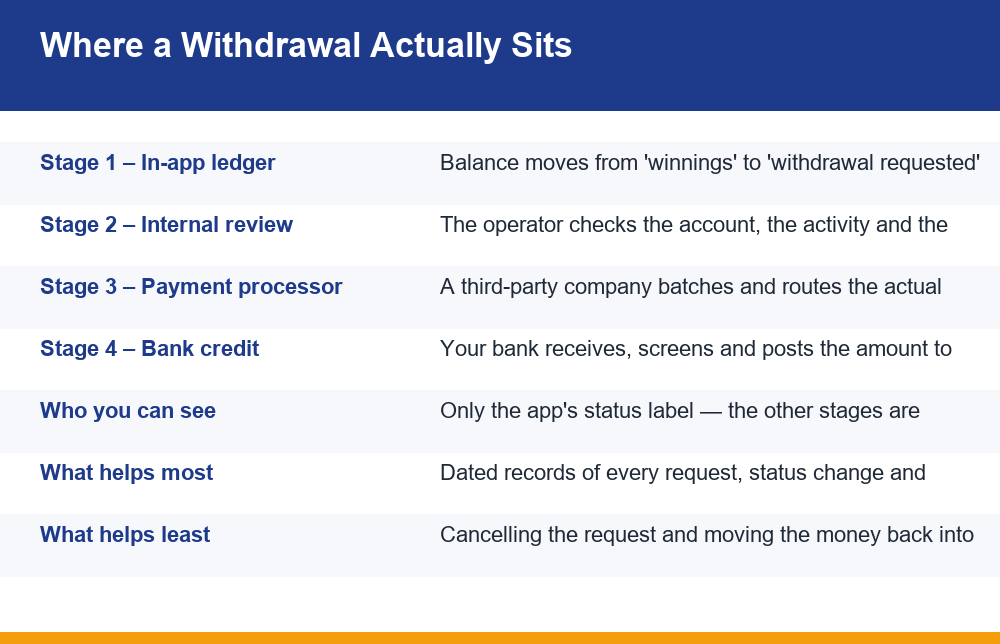
Whatever the app is called and however its marketing describes withdrawals, the money follows broadly the same four-stage route. The app only ever shows you a single status word — pending, processing, approved — which compresses all four stages into one label and hides where the hold-up actually is.
| Stage | What actually happens | Typical reasons it stalls |
|---|---|---|
| In-app ledger | Your request moves the amount from your playable balance into a withdrawal queue inside the app’s own database | Queued behind other requests; minimum amounts not met; bonus or promotional credits locked until playthrough conditions clear |
| Internal review | The operator’s team or automated system checks the account, recent activity and the payment details you supplied | Identity documents requested or rejected; name on the bank account not matching the app profile; unusual win patterns flagged for manual checking |
| Payment processor | A separate payments company receives the instruction and routes the transfer through banking rails | Batch runs only at set times; weekends and bank holidays; transfer limits; the processor’s own screening queues |
| Bank credit | Your bank receives the transfer, screens it and posts it to your account | Incoming-payment checks on unfamiliar senders; wrong or outdated account details; credits held pending verification |
Two things follow from this structure. First, at least two of the four stages — the processor and your bank — are companies the gaming app does not control, so even a well-run app cannot truthfully promise an exact arrival time; this shared control is one reason gaming app payout delays happen even when nobody in the chain is acting in bad faith. Second, the app’s support team can usually only see and influence the first two stages, which matters when we come to what contacting support can realistically achieve.
7 Honest Reasons the Money Sits in Limbo
Promotional pages tend to blame every delay on the user — wrong details, incomplete verification — while angry forum posts blame every delay on theft. Reality is messier. These are the seven reasons that, between them, account for most stuck withdrawals on real-money gaming apps of every kind.
- Verification was never completed. Many apps let you deposit and play with minimal checks but require identity and bank-detail confirmation before the first withdrawal. The request sits frozen until documents are submitted and accepted — and rejected photos or mismatched names restart the clock.
- The name trail does not match. If the bank account, the app profile and the identity document carry different spellings or different people’s names, the payment fails the name-matching checks that banks and processors run. Withdrawals to an account in someone else’s name are routinely refused outright.
- Bonus money came with strings. Credits from sign-up offers, referral rewards and promotional top-ups usually cannot be withdrawn until wagering conditions are met. Apps count balances in ways that are easy to misread, so part of what looks like withdrawable money may be locked. We explain this mechanic to warn about it, not to help anyone chase it.
- A manual review was triggered. Large wins, sudden changes in playing pattern, new devices and new payment details all push requests out of the automatic queue and into a human-review pile that moves at office speed, not app speed.
- The processor batches transfers. Many payment companies send money out in scheduled runs rather than continuously. A request made just after a batch leaves can wait a full cycle before it even starts moving, and weekends add dead days.
- The operator is managing its own cash flow. A less comfortable reason: apps running on thin reserves sometimes slow withdrawals deliberately, approving small amounts quickly while large ones queue. A pattern of ever-lengthening delays across many users is one of the strongest warning signs an app is in trouble.
- The request was edited or cancelled. Changing the amount, updating bank details mid-wait, or cancelling and re-requesting typically deletes your place in the queue and starts every check again. The single most common self-inflicted delay is impatience with an earlier delay.
Notice that only one of the seven involves anything sinister. That is precisely why a blanket assumption of theft is as unhelpful as blind trust: the sensible response is to work out which reason fits your case, and the evidence for that comes from records, not from feelings.
Pending Payout: Normal Wait or Warning Sign
A pending status is normal for a few business days, especially on a first withdrawal, after a big win, or across a weekend. The four-stage pipeline simply takes that long when any stage involves a human or a batch schedule. If the app told you upfront that withdrawals take, say, three to five working days and you are inside that window, the delay is unremarkable however uncomfortable it feels.
The picture changes when the delay stops behaving like a queue and starts behaving like avoidance. Warning signs worth taking seriously include: the stated processing window passing with no status change and no explanation; support replying with copy-paste reassurances that never mention your specific request; verification demands that keep escalating after each document is accepted; small withdrawals arriving while larger ones stall indefinitely; and — most telling of all — the app actively suggesting you cancel the withdrawal and receive an instant bonus instead. A legitimate backlog does not try to sell you something.
There is one more asymmetry to watch: an app that processes your deposits instantly has proven its payment rails work in real time. When the same app claims technical problems only ever affect money moving toward you, treat the explanation with suspicion and start tightening your records, as described below.
What Contacting Support Can and Cannot Do
Contacting support is worth doing — but mostly for reasons other than speed. A support agent can genuinely help with the first two pipeline stages: they can tell you whether verification is complete, whether a document was rejected, whether the request is in an automatic queue or a manual review, and whether your bank details passed validation. Fixing a rejected document or a mistyped account number through support really does shorten gaming app payout delays caused by those problems.
What support cannot do is reach into the payment processor or your bank and push one transfer ahead of the rest. Once a withdrawal has been approved and handed to the processor, the app’s agents are watching the same status you are. Repeated chasing at that point changes nothing except your stress level — and opening multiple tickets about the same request can, on some systems, flag the account for yet another review.
The better way to think about support contact is as evidence-gathering. Every exchange creates a dated, written record of what the operator said and promised. Ask specific questions — which stage is my request at, what is outstanding on my side, what is your stated processing time — and keep the answers. Prefer chat or email over phone calls precisely because they leave a transcript. If the delay later needs to be escalated anywhere, that transcript becomes the backbone of your complaint; if the money arrives tomorrow, keeping it cost you nothing.
How Waiting Pulls You Back Into Playing
Here is the part the promotional pages never mention: a delayed payout is not just a payments problem, it is a behavioural trap. While the money sits in limbo you keep opening the app to check the status — and every time you open it, you walk past the games, the banners and the bonus offers. The app that is slow to pay you is, in the same moment, fast to tempt you. Checking becomes browsing, browsing becomes one quick game, and the withdrawal gets cancelled to top up the stake. This is the same mechanism described in our breakdown of how the gaming habit loop turns checking into playing — cue, action, variable reward — except the cue is now the delay itself.
Some of this is designed. A balance shown in large friendly numbers on every screen, a withdrawal that can be cancelled with one tap while requesting it took five, an offer of instant bonus credit if you reverse the payout: each of these makes going backwards easier than waiting. Even without dark patterns, the psychology works against you — money already requested starts to feel lost, and playing feels like a way to take control of an uncontrollable wait.
The waiting period is also when spending quietly compounds. People top up with fresh deposits so they can keep playing while the old money is stuck, and the new spending hides inside the frustration of the delay. If that pattern sounds familiar, the piece on hidden gaming spending that builds up without being noticed shows how these small top-ups accumulate. A simple protective rule for the waiting period: check the payout status at most once a day, at a set time, through the app’s notification or email if possible — and treat any urge to cancel the withdrawal as a signal to close the app, not act in it.
A Records-First Response While You Wait
Whatever the delay turns out to be, the response that costs nothing and helps in every scenario is the same: build a file. If the payout arrives, you delete it. If the delay becomes a dispute, the file is the difference between a specific, evidenced complaint and an unprovable grievance. Start the file on day one, not when you get angry.
- Screenshot the withdrawal request itself: amount, date, time, the status label and any reference number the app shows.
- Screenshot your balance immediately before and after the request, so the amount deducted is documented.
- Save the app’s own stated processing time — from its help pages or the withdrawal screen — as it reads today, since such pages change quietly.
- Keep every support exchange in full: chat transcripts, emails, dates, agent names, and exactly what was promised.
- Note every status change with its date, building a simple timeline you could hand to a stranger.
- Keep your deposit records from the same period — your bank or UPI statement showing money going in proves the account relationship.
- Record the app version, your registered details and the bank account the payout should reach, so mismatches can be spotted and fixed early.
One warning belongs here because it catches people at exactly this vulnerable moment: a public complaint about a stuck withdrawal often attracts strangers offering to recover your money for an upfront fee. These approaches are almost always a second scam aimed at people already losing money to a first problem — the patterns are laid out in our piece on recovery scams that target people chasing stuck gaming money. No genuine resolution process begins with you paying a stranger who contacted you.
When a Delay Deserves a Formal Complaint
Patience should have a deadline, and the app’s own stated processing time sets it. A reasonable escalation path looks like this: wait out the full stated window plus a couple of working days for bank-side lag; raise one clear, written support request citing your reference number and timeline; give that request a stated response time of its own. If the window passes with silence, recycled non-answers, or pressure to cancel the withdrawal and keep playing, the matter has moved beyond customer service.
At that point, stop treating it as a conversation with the app and start treating it as an incident to report. In India, suspected online financial fraud — including money withheld by an online gaming operation — can be reported through the government’s National Cyber Crime Reporting Portal, which also runs the 1930 helpline for financial cyber fraud; reporting promptly matters because early reports give banks the best chance of tracing where money went. This is where the file you built pays off: the timeline, screenshots and transcripts drop straight into a complaint form.
Two final pieces of perspective. First, reporting is not an act of revenge — it is how patterns get spotted, and your report may be the one that connects a hundred smaller ones. Second, if the stuck money has you deciding whether rent or the app balance matters more this month, the payout is no longer the biggest issue on the table. Persistent gaming app payout delays hurt most when the money was never spare to begin with, and free, confidential support for the playing itself exists and works. Dealing with the delay and dealing with the habit are two different tasks — this page covers the first, and the rest of this site exists for the second.
Frequently Asked Questions
Why do gaming apps delay withdrawals?
Most gaming app payout delays happen because withdrawals pass through four stages — the app’s internal ledger, an operator review, a third-party payment processor, and your bank — and each adds its own checks, queues and batch schedules. Common specific causes include incomplete identity verification, name mismatches between the app profile and the bank account, locked bonus credits, manual reviews after large wins, and processor batch timing. Deposits feel instant because they skip most of these checks; the exit route never does.
Is a pending payout normal or a warning sign?
Pending for a few business days is normal, especially on a first withdrawal, after a large win, or over a weekend. It becomes a warning sign when the app’s own stated processing window passes without explanation, support sends only copy-paste replies, verification demands keep escalating, small payouts arrive while large ones stall, or the app offers you a bonus to cancel the withdrawal. An app that pays deposits instantly but claims technical problems only on payouts deserves extra suspicion.
Does contacting support speed up a payout?
Only when the delay is caused by something support can actually fix — a rejected document, a mistyped bank detail, or incomplete verification. Once a withdrawal has been handed to the payment processor, support agents are watching the same status you are, and repeated chasing changes nothing. The real value of contacting support is the dated written record it creates: ask specific questions over chat or email and keep the transcripts in case the delay becomes a formal complaint.
Why does a delayed payout tempt people to keep playing?
Because checking the status means opening the app, and the app surrounds the status screen with games, banners and offers. Cancelling a withdrawal is usually one tap while requesting it took several, and some apps offer instant bonus credit for reversing a payout. Money stuck in limbo also starts to feel lost, which makes playing feel like regaining control. A practical defence is to check the status once a day at a fixed time and treat any urge to cancel the withdrawal as a cue to close the app.
What records should I keep while waiting?
Screenshot the withdrawal request with its amount, date, status and reference number; your balance before and after; and the app’s stated processing time as it reads today. Keep full support transcripts with dates and agent names, a simple dated timeline of every status change, bank or UPI statements showing your deposits, and the exact account details the payout should reach. If the money arrives, delete the file; if it does not, the file becomes the backbone of your complaint.
When should a delay be reported, and where?
Escalate once the app’s stated processing window plus a couple of working days has passed and a clear written support request has produced silence, recycled non-answers, or pressure to cancel the withdrawal. In India, suspected online financial fraud including withheld gaming payouts can be reported through the National Cyber Crime Reporting Portal at cybercrime.gov.in, which also operates the 1930 financial fraud helpline. Report promptly and attach your timeline, screenshots and support transcripts.
