
Gaming invite code scams – 8 Proven Red Flags in Referral Offers
Gaming invite code scams persist because of one uncomfortable fact: almost everything published about invite codes is written by the people distributing them. Search for any referral code and the results are pages whose author earns a commission the moment you sign up and deposit. That means the single thing most pages on this topic get wrong is the framing itself – they describe the code as a gift to you, when it is actually a payment channel for them.
This breakdown maps how the generic referral funnel works across real-money gaming apps, who actually earns at each step, why codes travel through family and friend groups, and the eight red flags that separate an ordinary referral from a recruitment scheme. A short honesty note before we start: real-money gaming is for adults aged 18 and over, it carries real financial risk, and over time losses are the expected outcome for players.
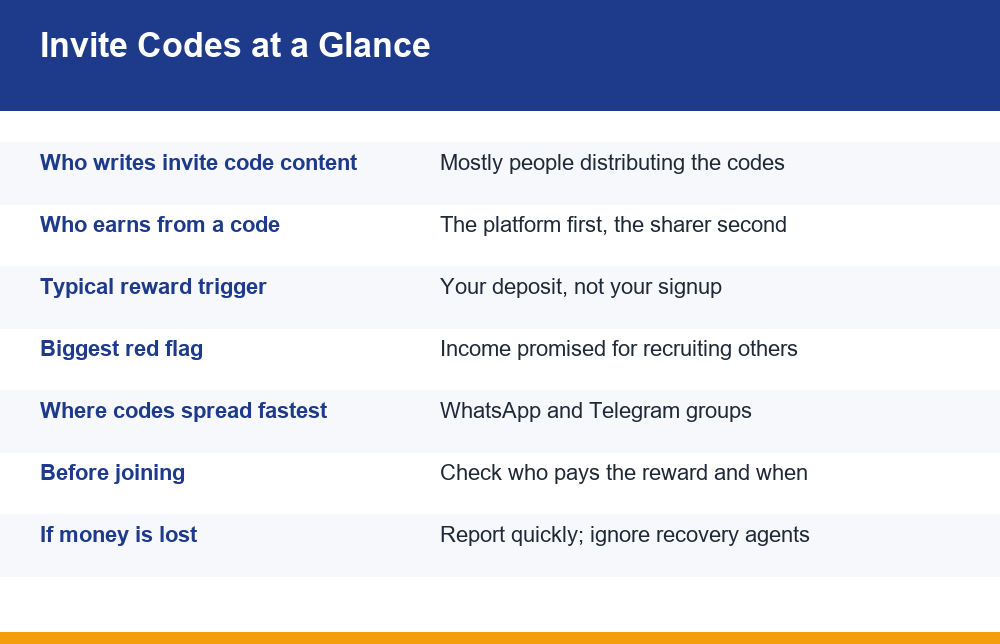
How Invite Codes Actually Work
An invite code is a tracking tag. When you enter someone’s code at signup, the app links your new account to theirs in its database. From that moment, a slice of your activity – your first deposit, your wagering volume, sometimes your losses – is credited to the person who referred you. The code does not unlock a secret version of the app, a better payout rate, or special treatment. It simply tells the operator who to pay for delivering you.
The reward structure is rarely symmetrical. The new player usually receives a small signup bonus that is locked behind wagering conditions, while the referrer receives cash or credit that is often tied to the new player actually depositing money. This is the first thing to understand about gaming invite code scams: the reward you are promised and the reward the sharer receives are different products with different conditions, and the sharer’s reward almost always depends on you spending.
Some apps pay a flat fee per verified referral. Others pay a percentage of the referred player’s deposits or losses for weeks or months. The second model matters more, because it means the person who invited you has an ongoing financial interest in you continuing to play – and continuing to lose. Once you see the code as a tracking tag with money attached, the enthusiasm around it starts to make sense.
Who Actually Earns From a Referral Funnel
Picture the funnel as a chain. At the top sits the operator, which pays out referral rewards only because referred players, as a group, deposit far more than the rewards cost. In the middle sit high-volume sharers – people running Telegram channels, YouTube comment campaigns, or coordinated WhatsApp forwarding – who treat code distribution as a job. At the bottom sit ordinary players who forward a code to a cousin or a colleague hoping for a small bonus.
The money flows upward. The operator keeps the margin on every game, which no referral bonus changes. The professional distributors earn meaningful commissions because they recruit at scale. The ordinary player at the bottom typically earns a token credit – frequently locked until they wager it several times over – while taking on the full risk of their own deposits. This answers the question of why people push invite codes so hard: the pushing is paid. The more aggressive the push, the more likely the pusher is a commissioned distributor rather than a satisfied player.
- Operator: earns the margin on all play; referral costs are a marketing budget, not generosity
- Professional distributors: earn per-signup fees or a cut of referred deposits, sometimes for months
- Ordinary sharers: earn small locked bonuses that usually require further wagering to withdraw
- New joiners: receive the smallest reward and carry all of the deposit risk
None of this requires anyone to lie. A referral funnel can be completely honest and still be structured so that the person forwarding the code benefits from your losses. The scam variants simply push the same structure further – which is where the red flags come in.
8 Red Flags in Gaming Invite Code Scams
These eight signs separate a routine referral programme from something designed to exploit you. One red flag alone is a caution; two or more together are a strong reason to walk away. Gaming invite code scams rarely show just a single sign – they tend to stack several.
- Income is promised for recruiting, not playing. The pitch centres on how much you will earn by bringing in others – a recruitment structure, not a game.
- The reward only unlocks after your deposit. A ‘free’ bonus that activates when you pay is not free; it is a discount on spending you were talked into.
- Screenshots of earnings are the main evidence. Payment screenshots are trivial to fake and are the standard prop in recruitment pitches.
- Urgency and scarcity framing. ‘Code expires tonight’ and ‘only 50 slots left’ exist to stop you checking anything.
- The app is sideloaded, not installed from an official store. A code that only works on an APK file sent through chat removes every layer of review between you and the developer.
- Withdrawal requires another condition you were not told about. Minimum wagering, a second deposit, or recruiting a set number of friends before cashing out.
- The sharer cannot explain how the programme pays. Anyone legitimately referring you can say who pays the reward, when, and under what condition.
- Support exists only inside a chat group. No published help channel means no recourse when the reward never arrives – and chat-group ‘support agents’ are a known trap, closely related to fake customer care numbers that circulate alongside gaming apps.
Notice that none of these flags require technical skill to check. They are all visible in the pitch itself, before you install anything or enter any code.
Referral or Pyramid-Style Scheme: Compared
The honest question underneath most invite code worries is structural: am I being referred to a product, or recruited into a chain? The distinction is not about how the offer feels – both are presented warmly, often by people you trust. It is about where the money comes from.
In a plain referral, the operator pays a one-time marketing cost for a new customer, and the chain stops there. In a pyramid-style structure, your value to the person above you is primarily your ability to recruit the people below you, and rewards are tiered so that each layer feeds the one above it. The table below puts the two side by side.
| Question | Ordinary referral | Pyramid-style recruitment |
|---|---|---|
| Where does the reward money come from? | Operator’s marketing budget | Deposits of people recruited below you |
| What are you asked to do? | Sign up and play | Sign up, deposit, and recruit others |
| How many levels earn from you? | One – the person whose code you used | Two or more layers above you |
| When does the sharer stop earning? | After a fixed reward or fixed period | As long as the chain beneath keeps growing |
| What happens when recruitment slows? | Nothing – the product continues | Payouts stall and the latest joiners absorb the loss |
| Main pitch | Try this app | Earn by building your team |
If the answer to ‘how do I earn more?’ is always ‘bring more people’, you are looking at recruitment economics, whatever the app on top of it looks like.
Why Codes Spread on WhatsApp and Telegram
Invite codes travel through messaging apps for three practical reasons. First, trust transfer: a forward from a family member or school friend arrives pre-trusted in a way no advertisement can match, which is exactly why distributors aim codes at family and friend groups rather than public pages. Second, invisibility: a claim made in a private group cannot be fact-checked by outsiders, flagged by a platform’s review system, or archived for anyone to examine later. Third, speed: forwarding costs the sharer nothing and takes one tap, so a commissioned distributor can seed dozens of groups in an hour.
There is also a quieter mechanism at work. When someone has already deposited and lost money under a code, recruiting others becomes a way to claw something back – the referral commission offsets their own losses. This is how gaming invite code scams convert victims into distributors: the person forwarding the code to your family group may themselves be trying to recover from it. Treat the medium as a signal. An offer that lives only in closed chat groups, with no presence anyone can publicly inspect, has chosen that environment deliberately.
The same closed-group dynamic later produces a second wave of harm: once losses happen, the same channels fill with people offering to get your money back, a pattern covered in our breakdown of recovery scams that target people who lost money on gaming apps.
Can an Invite Code Cost You Money?
Entering a code is free. What follows it usually is not, and the costs arrive in layers. The obvious layer is the deposit the bonus nudges you toward: most signup rewards activate only after a first deposit, and wagering requirements then keep that money in play until the operator’s margin has worked on it. Losing deposited money is not a malfunction of these apps – across all players and enough time, it is the expected outcome.
The less obvious layers can cost more. A sideloaded app installed for the sake of a code can carry permissions that read your messages or contacts. A signup flow can harvest your phone number, identity documents, and payment details for resale. A ‘withdrawal fee’ or ‘account verification charge’ can be invented at exactly the moment you try to take money out. And the social cost is real too: people who recruit relatives into a scheme that collapses carry that damage long after the money is gone.
One protective habit outranks all others here: decide what you are willing to lose before any code, bonus, or group pressure enters the picture. Setting a personal loss limit before you ever deposit turns a vague intention into a fixed number, and a fixed number is much harder for a bonus offer to talk you past. If a reward only makes sense when you ignore your own limit, the reward is doing exactly what it was designed to do.
What to Check Before Joining Under a Code
A five-minute check before entering any code removes most of the risk. None of these steps require expertise – they are questions with findable answers, and the pattern of answers tells you what you are dealing with.
- Who pays the reward, and when? Find the programme’s own written terms. If the only description of the reward is the sharer’s message, stop.
- Does the reward require a deposit? If yes, price the offer honestly: you are being paid a small amount to put a larger amount at risk.
- What are the withdrawal conditions? Look for wagering multiples, minimum balances, and time limits before you join, not after.
- Is the app on an official store? A code that only works through a forwarded APK file fails this check immediately.
- What does the sharer earn? Ask directly. An honest referrer answers in one sentence; evasion is information.
- Is there a published support channel? A real help page or in-app support, not a chat-group admin.
- Would you install this app without the code? If the answer is no, the code is the product being sold to you – and you are the product being sold upward.
The last question is the most useful one. Invite codes are designed to make the decision feel social – about the person asking – rather than financial. Moving it back to a financial decision, made against your own written limit, is the whole game.
What to Do If You Have Already Joined
Joining under a code is not a catastrophe, and panic helps nobody. Work through the situation in order. First, stop depositing – whatever has happened so far, no further money goes in while you assess. Second, document everything: screenshots of the original invite message, the code, the terms you were shown, your deposits, and any withdrawal attempts, with dates. Third, attempt a withdrawal of whatever balance exists, and record the outcome either way.
If you were charged unexpected fees, blocked from withdrawing, or deceived about what the code committed you to, and you are in India, report it through the National Cyber Crime Reporting Portal at cybercrime.gov.in – prompt reporting matters because it improves the chance of payment channels being traced. Keep your documentation; a clear timeline is the most valuable thing you can attach to any report.
Two warnings for the aftermath. Anyone who contacts you offering to recover your lost money – for an upfront fee, a ‘processing charge’, or remote access to your phone – is running the second act of the same scheme. And do not search for the app’s helpline number online and call whatever appears first; circulating numbers are routinely planted by scammers. Finally, do not forward the code onward to offset your losses. That is precisely the mechanism that keeps these funnels alive, and the person who sent it to you may have been caught in it the same way. Breaking the chain at your link costs you a small bonus and spares everyone below you the rest.
Frequently Asked Questions
How do gaming app invite codes actually work?
An invite code is a tracking tag. Entering it links your new account to the referrer’s account, so the operator knows who to pay. The referrer’s reward is usually triggered by your first deposit or your wagering volume – not merely by your signup – which is why code sharers encourage you to deposit quickly.
Why do people push invite codes so hard?
Because the pushing is paid. Many apps pay a fee per referred depositor, and some pay the referrer a percentage of the referred player’s deposits or losses for weeks or months. Aggressive promotion is usually a sign the sharer is a commissioned distributor, or a player trying to offset their own losses with referral earnings.
Can an invite code cost me money?
Entering the code is free, but the reward it promises almost always activates only after you deposit, and wagering conditions then keep that deposit at risk. Additional costs can include invented withdrawal fees, data harvested during signup, and malicious permissions in sideloaded apps installed for the code.
What is the difference between a referral and a pyramid-style scheme?
In an ordinary referral, the operator pays a one-time marketing reward and the chain stops at one level. In a pyramid-style structure, rewards flow upward through multiple layers and your main value is recruiting others. If the answer to ‘how do I earn more?’ is always ‘bring more people’, it is recruitment economics.
Why do invite codes spread on WhatsApp and Telegram?
Closed messaging groups transfer trust (a forward from family arrives pre-trusted), avoid public scrutiny (claims cannot be fact-checked or archived by outsiders), and cost nothing to scale. People who have already lost money also forward codes to recover losses through commissions, which converts victims into distributors.
What should I check before joining under a code?
Read the programme’s own written terms: who pays the reward, whether it requires a deposit, and the exact withdrawal conditions. Confirm the app comes from an official store, ask the sharer what they earn, and check for a published support channel. Above all, ask whether you would install the app without the code – if not, decline.
