
Hidden gaming spending – 9 Honest Signs a Loved One Needs Help
The short answer: hidden gaming spending almost always leaves two trails — a money trail and a behaviour trail — and the money trail is usually a pattern of small, repeated deposits rather than one dramatic transfer. If you are reading this because something feels off at home, you do not need proof before you act. You need enough clarity to tell the difference between a bad month and a pattern, and a way to raise it that does not end in a slammed door. This breakdown covers the nine signs families actually notice first, what the transactions look like on a statement, why people conceal losses even from people they trust, and how to open the conversation without an accusation.
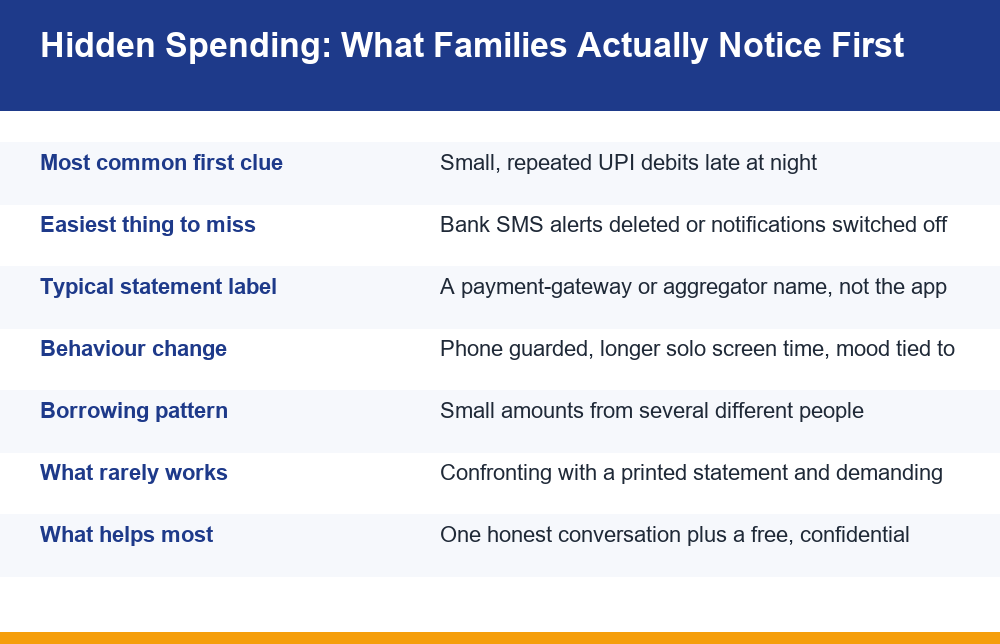
Hidden gaming spending explained in plain terms
Hidden gaming spending is money moving into real-money gaming apps that the rest of the household does not know about. The hiding is rarely elaborate at the start. It usually begins as something not worth mentioning — a few hundred rupees on a slow evening — and becomes concealment only once the amounts stop matching the story the person has been telling themselves.
That gradual slide matters, because it changes what you are looking for. Families often expect to find a single large withdrawal or a loan nobody can explain. What they more often find is frequency: dozens of modest debits spread across weeks, timed to evenings and weekends, interrupted by occasional credits back from the same source. One deposit tells you very little. A rhythm of deposits tells you a great deal.
There is also the question of who notices. In most households the person who spots it first is whoever handles the shared money — the one who reconciles the bills, watches the balance before an EMI date, or fields the request for a small loan at the end of the month. If that is you, the discomfort you are feeling is information rather than paranoia. You sit closer to the household’s cash flow than anyone else does, and a change in its rhythm is exactly the thing you are placed to see first.
It also helps to separate spending from harm. Someone can spend a fixed, affordable amount openly and be fine. Someone else can spend less and be in real trouble, because the money is borrowed, the sessions are secret, and the losses are being chased. The concealment is the signal worth paying attention to — not the number on its own. If you want the fuller picture of how habits escalate, the mechanics are set out in our breakdown of how a gaming habit loop builds and reinforces itself.
Three things this is not, and it is worth being clear before you start looking:
- Not a moral failing. These products are engineered to be absorbing. Getting pulled in is a design outcome, not a character flaw.
- Not a maths problem to be solved. There is no system, no pattern and no streak that beats the built-in margin. Over time, losses are the expected outcome by design.
- Not something you can fix by surveillance alone. Checking tells you what is happening. Only a conversation changes it.
9 honest signs a loved one needs help
None of these nine signs proves anything by itself. Any one of them has an innocent explanation; three or four together, sustained over a month or more, is a pattern that deserves a direct conversation. The signs of hidden gaming spending split roughly into money signals you can verify and behaviour signals you can only observe.
- Bank alerts have gone quiet. SMS alerts deleted before anyone else sees the phone, email receipts moved to a folder, or transaction notifications switched off entirely. A person with nothing to conceal has no reason to silence their own bank.
- Small, frequent debits that cluster at night. Twenty transactions of ₹200 draw far less attention than one of ₹4,000 — and that is precisely why the pattern forms. Look at timing and count, not size.
- Money borrowed in small amounts from several people. A cousin here, a colleague there, a friend who is owed something from last month. Spreading the borrowing keeps any single lender from seeing the scale.
- Salary that disappears in the first week. The month starts comfortable and ends on requests for help, repeatedly, without a change in income or expenses that explains it.
- New, unexplained short-term credit. Instant loan apps, a card used for cash rather than purchases, or a balance that never falls. Credit entering the picture is one of the clearest escalation markers.
- The phone becomes guarded. Screen tilted away, app folders rearranged, the device carried into rooms it never used to go. Secrecy about the device usually tracks secrecy about the spending.
- Mood that rises and falls with sessions. Irritability during interruptions, elation or flatness afterwards, and a short fuse around any question about money.
- Sleep and attendance slipping. Late nights that are not explained by work, difficulty getting up, missed commitments, declining focus at work or in studies.
- Promises to stop that reset every few weeks. Genuine intention, a short clean period, then a quiet return. Repeated failed self-imposed stops are among the most reliable indicators that outside help is needed.
Read that list as a cluster rather than a checklist to be ticked. Signs one to five are things you can usually corroborate against a record; signs six to nine are things only someone living in the same house will see. When the two halves agree — the statement shows a rhythm and the behaviour has changed in the same weeks — that agreement is far more informative than any single item, and it is the point at which waiting for more certainty stops being useful.
One extra note on the behavioural half of that list: do not interpret denial as proof of dishonesty. People in this situation frequently believe their own account of it, because the next session is always framed as the one that squares the ledger. That belief is part of the problem, not evidence of bad faith.
What gaming app transactions look like on a bank statement
This is the question families ask most, and the honest answer is that statements rarely say anything as convenient as the name of the app. Deposits usually pass through a payment gateway, aggregator or wallet, so the narration shows the processor rather than the destination. That is why hidden gaming spending can sit in plain sight on a statement for months without anyone reading it as unusual.
What you can read reliably is shape. The table below sets out what tends to distinguish gaming-related deposits from ordinary everyday spending.
| What to look at | Ordinary spending | Pattern worth a closer look |
|---|---|---|
| Narration | Recognisable merchant or shop name | Payment gateway, aggregator or wallet name you cannot place |
| Amounts | Varied and tied to real purchases | Round, repeating figures — the same few values again and again |
| Frequency | A handful of debits a day at most | Many debits in one evening, sometimes minutes apart |
| Timing | Spread across working hours | Clustered late at night, weekends, or straight after salary credit |
| Direction | Almost entirely outgoing | Mostly outgoing with occasional credits back from the same channel |
| Method | Cards, standing instructions, bills | Heavy UPI and wallet top-ups, often to the same handful of handles |
| Month shape | Fairly even across the month | Front-loaded, then borrowing or credit use near month end |
The occasional incoming credit in that fifth row is the detail most people misread. A withdrawal coming back in looks reassuring — evidence that money is being recovered. In practice, credits of that kind are usually a fraction of what went out, and they frequently go straight back in. When you are assessing the picture, total the debits for a full month and compare them to the credits. The gap, not any single line, is the real number.
Be equally clear about what a statement cannot tell you. It cannot tell you what the money was for, whether a particular session ended up or down, or whether anything was recovered afterwards. It also cannot show money that never touched that account at all — cash borrowed from a friend, a wallet topped up from somebody else’s balance, or spending routed through a second account you do not see. A statement narrows the question; it does not settle it. That limitation is one more reason the checking stage has to end in a conversation rather than a verdict.
One caution while you are looking: never follow a link or scan a code sent by anyone claiming they can help recover lost money, and never share account details, card numbers or one-time passwords with them. Unprompted “recovery” offers that arrive after losses are a known predatory mechanic, and households already under financial stress are the intended target. It is mentioned here as a warning, not as something to engage with.
Why people hide gaming losses from family
Understanding the reason behind concealment is not an academic exercise. It directly shapes whether your first conversation goes anywhere. People hide hidden gaming spending for reasons that are mostly ordinary and human, and almost never because they enjoy deceiving the household.
The first reason is shame. Losing money feels like a failure of judgement, and the size of that failure compounds with each session. Admitting to ₹5,000 is uncomfortable; admitting to ₹50,000 after months of denial feels impossible. Silence is not chosen once — it is re-chosen every day, and it gets harder to break the longer it runs.
The second reason is the belief that it is temporary. Nobody intends to confess a problem they expect to solve by Friday. As long as the next session is imagined as the correction, there is nothing to disclose yet — only a situation being handled. This is also why ultimatums tend to backfire: they arrive while the person still believes they are days away from making the whole thing moot.
The third reason is protective. Many people conceal spending specifically to spare a spouse or parent worry, or to avoid being the cause of a household argument about money. That instinct is misguided but sincere, and it is worth naming out loud when you talk, because it gives the person a way into the conversation that is not a confession of betrayal. The broader framework for how households set expectations around real-money play is covered in our practical reference on responsible gaming habits in India.
A fourth reason sits underneath all three and is easy to miss: once concealment has started, the concealment itself becomes something to conceal. The person is no longer managing one problem but two — the money and the months of saying nothing about it. That is why disclosure so often arrives suddenly and in full rather than in instalments, and why the amount named first is frequently the amount that feels survivable to say out loud rather than the real total. If the figure you are given later turns out to be low, treat that as a feature of how this unfolds, not as a fresh betrayal to litigate.
How to check the money trail respectfully
There is a version of checking that builds trust and a version that destroys it, and the difference is mostly about consent and timing. Going through a partner’s phone while they sleep may well confirm hidden gaming spending — and it will also guarantee that the first conversation is about the breach of privacy rather than the money. Where you have a legitimate joint view of the finances, start there.
- Start with what is already yours to see. Joint account statements, shared household budgets, the family UPI history on a shared device, bills and EMIs you both manage. This is usually enough to establish whether a pattern exists.
- Look at a full month, not a bad week. Pull one complete statement cycle. Count the debits, total them, and note the timing. You are testing for rhythm, not collecting individual incidents.
- Write down three concrete observations. Not a case file — three things you noticed, with dates. Specific and few beats comprehensive and overwhelming every single time.
- Ask before you go further. For anything that is not jointly yours, say what you have noticed and ask the person to show you themselves. An invitation preserves the relationship; a search spends it.
- Protect the household’s essentials first. Rent, school fees, EMIs, medical money and emergency savings. Securing what the family cannot afford to lose is not an accusation, and it should not wait for agreement about anything else.
- Keep your own record simple and private. Dates and amounts, kept somewhere calm. It stops the conversation becoming an argument about whether last Tuesday happened.
It helps to decide in advance what result would be enough. Before you open the statement, settle what you will do if you find a clear pattern and what you will do if you find very little. Families who skip that step tend to end up in one of two dead ends: treating an ambiguous month as proof and over-reacting, or treating an obvious pattern as inconclusive and doing nothing for another three months. Setting your own threshold beforehand keeps the decision with you rather than with whatever the numbers happen to look like on the day you read them.
Two things to avoid at this stage. Do not announce an investigation — an audit that is narrated in advance mostly produces better concealment. And do not keep checking indefinitely as a substitute for speaking. Families sometimes spend months gathering more and more certainty because gathering feels safer than asking. Once you have a month of data and three clear observations, you have enough.
How to talk to your husband or son about gaming spending
Pick a dull moment. Not after a loss, not late at night, not in front of relatives, not during a crisis about money that is already underway. The worst time to raise hidden gaming spending is the moment you discover it, because that is when you have the most anger and they have the most to defend.
Lead with what you have noticed and what you are worried about, in that order, and stop. Then let silence do some work. The aim of the first conversation is not a full confession or a plan — it is simply to establish that the subject can be discussed in your house without the roof coming off. That alone is a significant outcome.
Openings that tend to work:
- “I have noticed money going out at night that I cannot place, and I would rather hear it from you than keep guessing.”
- “I am not angry about the money. I am worried about how much of your time this is taking.”
- “You don’t have to tell me the full number today. I just want to know whether this is something you are struggling to stop.”
- “Whatever the figure is, we will deal with it as a household. I need to know what we are dealing with.”
Things to leave out of the first conversation: the printed statement held up as evidence, the total you have calculated, comparisons to other people’s children or husbands, threats about leaving or disowning, and any demand for a promise on the spot. Promises extracted under pressure are cheap and are broken within weeks, which then becomes its own source of shame and a reason to conceal more carefully.
If the answer is an admission, resist the urge to convert it straight into a plan. The useful next move is a question rather than a schedule: ask what they think would actually help, and listen to the answer even when it is vague. People follow through far more often on a step they named themselves than on one handed to them in the first ten minutes. Agree one small, concrete thing for the coming week — a call to a helpline, shared visibility of one account, a ceiling set together — and leave everything else for later.
If the answer is denial, do not escalate. Say that you will leave it, that your concern has not changed, and that you are available whenever they want to talk. Then follow through on protecting the household essentials quietly. A door you leave open gets used far more often than one you kick down. If and when the person is ready to take practical steps, the most useful starting point is usually a hard ceiling on what can be spent — our breakdown of how loss limits work and why they fail in practice covers what actually holds and what does not.
Should the family take over finances when it gets out of control?
Sometimes, partially, and for a defined period — but not as a punishment, and not permanently by default. Taking full control of an adult’s money is a serious step, and done badly it produces resentment, secrecy and new borrowing channels rather than less hidden gaming spending.
A more workable middle path is to separate the money that the household cannot afford to lose from the money the person manages themselves. Essentials — rent, fees, EMIs, medical costs, emergency savings — move somewhere the person does not control day to day. Everything else stays with them, with agreed visibility rather than agreed permission. The point is to make the downside survivable for the family without stripping the adult of all autonomy.
Where a fuller handover genuinely is needed, make it explicit on four points: what exactly is being handed over, who holds it, what the review date is, and what has to be true for it to be handed back. An arrangement with an end condition is something a person can agree to. An indefinite arrangement with no stated exit is something they will work around, and working around it almost always means credit the family cannot see.
If the person refuses any change at all, you still have decisions that are entirely yours to make. You can decide what you will and will not lend. You can decide that household essentials are run from an account you manage. You can decide not to put your name behind any further borrowing. None of that needs their agreement, and stating it once, calmly, is better than renegotiating it every month. The aim is not leverage — it is making sure the family’s floor does not fall out while the person works out whether they want help.
Be realistic about what financial controls achieve. They limit damage; they do not treat the underlying habit. Families who rely on money controls alone often find the spending reappears the moment control relaxes, because nothing about the pull has changed. Controls buy time — time that is only useful if it is spent getting support.
Where to get free help and what to do this week
You do not have to manage this inside the family. Free, confidential support exists for the person spending and, importantly, for the people around them — and you are allowed to use it before your loved one has admitted anything at all. Many family members call a helpline first, simply to get a clear head about hidden gaming spending and work out what to say.
Confidential helplines and live chat for anyone affected by someone else’s gambling, including partners, parents and other family members, are available through GamCare’s support and live chat service. In India, free round-the-clock mental-health counselling is available on the national Tele-MANAS lines, 14416 and 1-800-891-4416, in several languages, which is a reasonable first call when sleep, mood or distress are part of the picture.
Look after yourself while this is going on. Living alongside someone else’s concealed spending is genuinely draining — the vigilance, the arithmetic at two in the morning, the suspicion that starts to sit inside ordinary conversations. Support aimed specifically at affected family members exists because that strain is well recognised, and using it is not disloyalty. Someone who is rested and clear-headed is also much better at the long, unglamorous part of this, which is staying available without becoming the household’s auditor.
Three things worth doing in the next seven days, in order: secure the household essentials, pull one full month of statements you already have the right to see, and have one short, low-temperature conversation. Not all three in one evening. If the conversation goes badly, that is a normal first attempt — the goal was to open a door, and the door stays open.
One closing honesty line, because it frames everything above: real-money play is for adults aged 18 and over, it carries real financial risk, and over time losses are the expected outcome rather than the exception. Nothing here is a method for recovering money, and no system or pattern beats the built-in margin. The realistic goal is not winning it back — it is stopping the bleeding and getting the person support.
Frequently Asked Questions
How can I tell if a family member is losing money on gaming apps?
Look for a pattern rather than a single incident. The most reliable combination is frequent small debits clustered at night or just after salary, bank SMS alerts deleted or switched off, small amounts borrowed from several different people, and a guarded phone. Any one of those has an innocent explanation; three or four together, sustained for a month, is a pattern worth a direct conversation.
What do gaming app transactions look like on a bank statement?
Usually not like the app at all. Deposits generally route through a payment gateway, aggregator or wallet, so the narration shows the processor rather than the destination. What is readable is the shape: round, repeating amounts, many debits in a single evening, clustering late at night or right after a salary credit, heavy UPI and wallet top-ups to the same few handles, and occasional credits back from the same channel that are far smaller than the outflow.
Why do people hide gaming losses from family?
Three reasons, mostly. Shame, because the amount feels like a growing failure of judgement and gets harder to admit each week. The belief that it is temporary, so there is nothing to disclose yet because the next session is imagined as the correction. And a protective instinct — concealing the spending to spare a spouse or parent worry. Deception for its own sake is rarely the motive.
How do I talk to my husband or son about gaming spending?
Choose a dull, calm moment, never straight after a loss or during a money crisis. Say what you have noticed and what you are worried about, then stop and let silence work. Leave out the printed statement, the calculated total, comparisons to other families, threats, and any demand for a promise on the spot. The aim of the first conversation is only to prove the subject can be raised safely in your house.
Should the family take over finances when gaming gets out of control?
Partially, and for a defined period, rather than fully and indefinitely. Move the money the household cannot afford to lose — rent, fees, EMIs, medical costs, emergency savings — out of day-to-day reach, and leave the rest with the person under agreed visibility. If a fuller handover is needed, state what is handed over, who holds it, the review date and the conditions for handing it back. Controls limit damage; they do not treat the habit, so use the time they buy to get support.
